The Georgia primaries are over, and the battle lines for November are drawn. With control of key statewide offices on the line—and a US Senate seat that could shape the balance of power in Washington—the 2026 midterms will test whether Georgia’s rightward drift in recent cycles holds, or whether Democrats can build on their 2020 and 2022 breakthroughs.
Here are the five races that will define the outcome.
US Senate
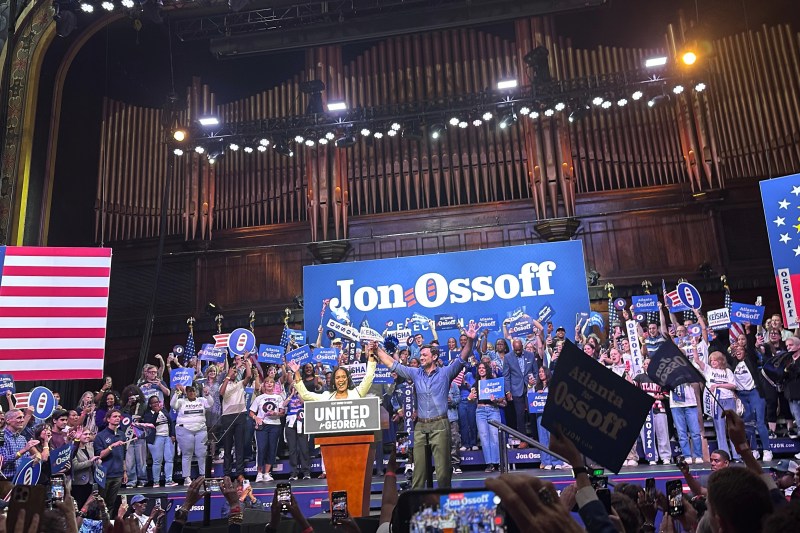
After a bruising Republican primary between former football coach Derek Dooley and Congressman Mike Collins, Collins, who represents the 10th Congressional District, emerged as the nominee. He’ll now face Democratic incumbent Sen. Jon Ossoff in what’s expected to be one of the most expensive and closely watched Senate races in the country.
Collins, who was first elected to Congress in 2022 on a staunchly pro-Trump platform, has built his national profile as an immigration hardliner and skeptic about the integrity of the 2020 presidential election. He is perhaps best known for being the primary sponsor in the House of the Laken Riley Act, which was the first bill President Donald Trump signed into law during his second term.
The law requires local authorities to detain undocumented individuals who have been arrested and charged with certain crimes, including shoplifting and other property offenses..
Collins has also drawn scrutiny for his conduct in office. A congressional investigation is currently examining whether his office paid an intern who allegedly never reported to work, a potential misuse of taxpayer funds that Ossoff and national Democrats have used to define Collins ahead of the general election.
Ossoff, concluding his first Senate term, arrives at this race with a record he’s eager to defend. He was sworn in alongside Georgia’s other Democratic senator, Raphael Warnock, in January 2021, and quickly rose to chair the Senate Permanent Subcommittee on Investigations—a powerful perch he’s used to launch sprawling inquiries, subpoena hundreds of witnesses, and produce detailed accountability reports. During Trump’s second term, Ossoff has sharpened his public profile as one of Washington’s most pointed critics of executive branch corruption.
On the trail, Ossoff has linked his opponent directly to the administration’s most unpopular policies. “Donald Trump’s handpicked candidate Mike Collins is a notorious bigot, antisemite, and extremist currently under federal investigation for the illegal misuse of tax dollars,” Ossoff said in a recent campaign statement. “Collins, who is only a congressman because his daddy was a congressman, voted to double health insurance premiums for more than a million Georgians, for war with Iran, and for the Trump tariffs.”
Governor
After what became the most expensive gubernatorial primary in Georgia history, billionaire healthcare executive Rick Jackson defeated Lt. Gov. Burt Jones, the Trump-endorsed candidate, to claim the Republican nomination.
Jackson, who was born in Atlanta and raised in public housing, built his fortune through Jackson Healthcare Industries, a company that operates primarily as a healthcare staffing agency. His rise to political prominence, however, has not been without controversy. During the COVID-19 pandemic in 2020, Jackson’s company received a no-bid contract and since then has made nearly $1 billion in pandemic response contracts from then-Gov. Brian Kemp (R)—a governor to whose campaign Jackson had been a regular financial contributor.
He will face former Atlanta Mayor Keisha Lance Bottoms, who won the Democratic primary in a landslide. Bottoms, who served as mayor from 2018 to 2022 and later joined the Biden White House as a senior adviser, has anchored her campaign on healthcare access—specifically, stabilizing Georgia’s struggling rural hospitals and expanding Medicaid. Georgia remains one of only ten states that has not expanded Medicaid under the Affordable Care Act, a policy decision that has about 192,000 Georgians without coverage.
Lieutenant governor
Democrats nominated State Sen. Josh McLaurin, who entered the general election with a notable trio of endorsements: Sens. Raphael Warnock and Jon Ossoff, and former gubernatorial candidate Stacey Abrams.
McLaurin’s campaign has centered on economic fairness—the argument that Georgia’s government has repeatedly tilted the playing field toward corporations at the expense of working families. He has criticized private equity firms buying up single-family homes and driving up housing prices, and has questioned generous tax incentives given to data centers and other large corporate interests. His platform also includes workers’ rights, civil rights, and reducing the cost of living.
Republicans nominated State Sen. Greg Dolezal, whose campaign was immediately engulfed in controversy after he released Islamophobic AI-generated ads promising to “Keep Georgia Sharia Free.”
Dolezal describes himself as one of the most conservative members of the state legislature. He sponsored and wrote counts for the Riley Gaines Act, which bans transgender athletes from competing in K-12 and collegiate sports in alignment with their gender identity in Georgia.
Secretary of state
Perhaps no Georgia office carries more electoral baggage than the secretary of state. Brad Raffensperger refused Donald Trump’s demand to “find 11,780 votes” in 2020, a moment of defiance that made him a national figure. Raffensperger is now stepping down after an unsuccessful bid for governor, and the race to replace him has attracted candidates whose views on that pivotal moment couldn’t be more different.
Democrats nominated Penny Brown Reynolds, a former Fulton County state court judge and Biden administration appointee. Her campaign for the office is focused on protecting Georgians’ voting rights, restoring public trust in government, supporting small businesses, and protecting senior citizens and other vulnerable communities from fraud..
Republicans nominated State Rep. Tim Fleming. Before joining the state legislature, Fleming served as Kemp’s chief of staff and deputy secretary of state under Kemp when Kemp ran the office from 2010 to 2018. First elected to the state House in 2022, Fleming helped shape election policy during his time in the legislature, including passing House Bill 1207, a bill that focused on revising ballot proofing procedures.
State Senate District 7
State Senate District 7 has become one of the most closely watched state legislative seats in Georgia. The seat opened up when incumbent Sen. Nabilah Islam Parkes, a Democrat, stepped down to run for insurance commissioner and later lieutenant governor. In 2022, Ruwa Romman made history as the first Palestinian and first Muslim woman elected to the Georgia State House of Representatives.
If elected to be a state Senator, Romman would become the first Arab American and first Palestinian American ever elected to the Georgia State Senate. Her platform centers on economic fairness and corporate accountability. She has pushed to end tax breaks for data centers and crack down on corporate landlords buying up single-family homes, and she is calling for a $15 minimum wage and the expansion of Medicaid.
She will face Republican Aizaz Shaikh in November, who ran unopposed in the GOP primary. The district’s rapidly growing South Asian and Muslim electorate—the same communities that helped elect both Romman and Islam Parkes—will likely determine the outcome.