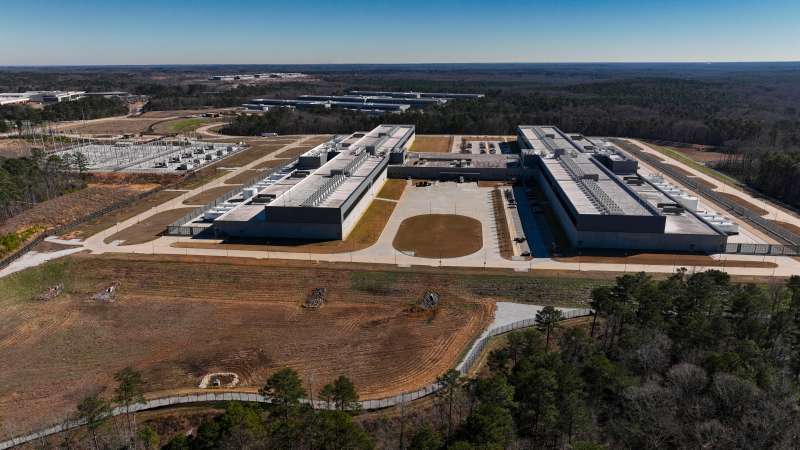
For decades, Fayette County was a verdant suburb of Atlanta, known for its community feel and ample wildlife.
But since construction on a Microsoft-QTS data center campus began in 2023, residents say the landscape has completely changed. Sweeping transmission lines now cut across the skyline and hulking industrial buildings loom over roads that once contained trees.
When it’s completed, the QTS data center is expected to span 6.6 million square feet, roughly 36 times the size of an average Walmart.
And Fayette County is far from alone. Across Georgia, data centers are multiplying at a pace that would have seemed inconceivable just a decade ago, reshaping communities, straining power grids, and draining water resources in the process.
But this growth did not happen by accident.
The tax break that keeps giving
At the heart of Georgia’s data center boom is a single policy decision: the state does not require companies building data centers to pay sales tax. Every piece of equipment, every cable, every server rack. All of it is purchased tax-free. The policy applies to some of the wealthiest corporations on the planet, including Amazon, Meta, and Microsoft.
In 2026 alone, Georgia is expected to lose $2.5 billion in sales tax revenue because of this exemption—664% more than the state’s own original estimate of $327 million.
The exemption was signed into law in 2018, by then-Governor Nathan Deal, with the logic that was familiar across the Sun Belt. Technology companies were growing fast, and Georgia wanted a piece of that growth.
What Deal’s administration could not have anticipated in 2018 was the coming era of what the industry calls “hyperscale” data centers: facilities of staggering size requiring hundreds of acres of land, enormous quantities of water for cooling, and power loads that can dwarf entire cities.
These are not the modest server rooms of the early internet age. They are industrial campuses, and they have been arriving in Georgia at a relentless pace.
Big promises, small paychecks
When communities across Georgia initially welcomed data centers, many were operating on an older model of economic development forged during the manufacturing era, said Science for Georgia’s Executive Director Amy Sharma.
A major employer arrives, brings hundreds of construction and full-time jobs, and the surrounding economy would bloom with restaurants, retailers, services, housing.
Data centers couldn’t be more different. After construction, data centers only provide about thirty jobs—less than an average McDonald’s.
When people realized how much energy—and how little economic opportunity—data centers would bring, Sharma said, they started “freaking out.”
But this didn’t change Republicans’ policy positions.
A veto that could have brought billions to Georgia
Public frustration has translated into enormous political pressure. A bipartisan bill that would have repealed the data center sales tax exemption passed the Georgia Legislature in 2024, a notable achievement given the partisan divisions that typically define the chamber.
But Gov. Kemp vetoed it.
“Giving data centers a tax break without investigating their impact on our environment and bill payers is short sighted,” Jennette Gayer, executive director of Environment Georgia, told the Georgia Recorder after the veto.
The decision drew sharp criticism from environmental advocates and residents who felt their concerns were being overridden by corporate interests.
Since then, opposition has only deepened. According to a recent Emerson College poll, only 31% of Georgians support data centers in their communities.
And yet, not a single data center bill passed during this year’s legislative session either, leaving billions of dollars on the table from some of the wealthiest companies in the world, like Meta.
Sharma says the outcome was not a surprise to those who watched the session closely. She estimated that more than 50 data center lobbyists were present in the Capitol during the session.
“As far as we were concerned, the rank and file was very excited about doing something and passing something,” she said.
“But most of the leadership was not at all excited. Most of these bills that went nowhere were quashed by either House or Senate leadership.”
Among the legislative leaders who have shown little appetite for data center reform is Lt. Gov. Burt Jones, who serves as the president of the Georgia Senate and determines what bills reach the floor for a vote.
According to the Georgia Recorder, his family is tied to a massive, potentially billion-dollar data center development project in Butts County, Georgia.
Meanwhile, data center construction across the state shows no signs of slowing down. Local municipalities are left to decide how to regulate data centers, until, potentially, the next legislative session.