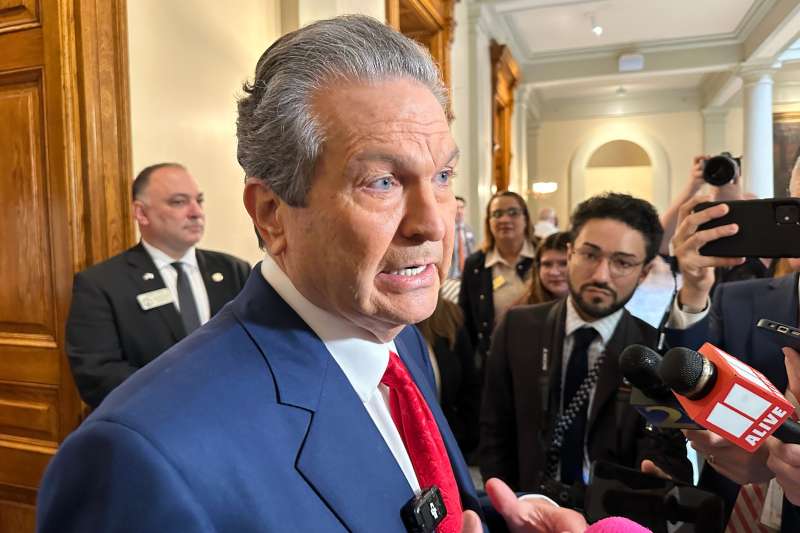
If you’ve turned on your TV in the last month, you’ve almost certainly seen a political ad paid for by Rick Jackson, a billionaire healthcare executive running for governor as a Republican.
His ads have compared Georgia’s Secretary of State Brad Raffensberger—the Republican official who certified the results of the 2020 election and a fellow primary opponent—to Judas. He’s also repeatedly portrayed Lieutenant Governor Burt Jones, another primary opponent, as a corrupt liar.
Jackson, the founder and CEO of Alpharetta-based Jackson Healthcare, entered the governor’s race in February. He has since poured more than $75 million of his personal fortune into the campaign, turning it into one of the most expensive primary races in Georgia history. He has said he is prepared to spend more than $100 million before the general election is over.
And it’s working. In multiple recent polls, he is ahead of both Jones and Raffensberger.
Jackson has been a Republican mega-donor for decades. FEC records show he gave more than $1 million to support Jeb Bush’s 2016 presidential campaign and $150,000 to Nikki Haley’s 2024 presidential bid. Both of them were, at the time, opponents to Donald Trump. Then, in December 2025, Jackson wrote a $1 million check to Trump’s MAGA Inc. PAC after attending an event at Mar-a-Lago. At the dinner, Jackson pulled Trump aside, according to Axios.
“Mr. President,” he reportedly said, “I’m going to be your favorite governor.”
Advocates across the political spectrum have raised concerns about what Jackson’s spending means for democracy in Georgia.
“It is a laughably corrupt system,” Lauren Groh-Wargo, CEO of Fair Fight Action and campaign manager for both of Stacey Abrams’ gubernatorial campaigns, told Courier Georgia. “We have a fundamentally unfair campaign finance regime in Georgia.”
Attorney General Chris Carr, also running in the Republican primary, put it more bluntly during a GOP gubernatorial debate in late April: “There’s one really rich guy and one guy’s rich daddy that are trying to buy your vote,” he said, referring to Jackson and Jones.

In addition to Jackson’s personal spending, a dark money group called “Georgians for Integrity” began running ads attacking Jones in late 2025. While Jackson has denied any connection to the group, reporting has found that lawyers who previously worked with Jackson on other political campaigns signed contracts related to these ads. The Georgia Ethics Commission has since opened an investigation to determine who is actually funding the group.
And enormous sums of money are not only impacting the gubernatorial race, but could influence what Jackson does as governor.
The healthcare executive made his fortune as the founder of Jackson Healthcare, a staffing agency that places nurses, doctors, therapists, and other medical workers at hospitals and nursing homes across the United States. The company reports more than $2.5 billion in annual revenue.
According to Healthbeat, when COVID-19 hit Georgia in early 2020, Jackson Healthcare received a no-bid contract, meaning no other companies were allowed to compete for the job. Jackson Health placed staff in hospitals and nursing homes across the state. By the time the work had been completed in 2023, the Georgia Department of Community Health had paid a Jackson Healthcare subsidiary approximately $700 million.
In total, Jackson Healthcare and its subsidiaries have received over $1 billion in payments from Georgia state agencies since 2020.
The company also has significant contracts from the Federal government. Facing South has reported that Jackson Healthcare received a $2.6 billion contract to provide staffing services in ICE detention centers around Georgia. If he becomes governor, Jackson would have direct influence over state cooperation with federal immigration enforcement, potentially shaping the conditions under which such contracts are pursued or expanded.
Jackson has promised to “unwind” his company’s ties to the state if elected, but Georgia law does not require a governor to terminate existing contracts. It also includes a carve-out that could allow a Jackson-owned company to continue receiving state business if no other company is qualified to perform the services required.
And as governor, Jackson would control the very agencies writing those checks. Separately, his personal relationships with federal officials could position his company to pursue expanded contracts with the Department of Homeland Security (DHS) and other federal agencies. He has not specified how he would handle current Jackson Healthcare contracts with DHS and ICE.
Groh-Wargo said what’s happening in Georgia reflects a growing pattern of personal enrichment at the national level.
“Self-enrichment is on full display and being very normalized. There’s a very Trumpian quality to Rick Jackson,” she said.
But she’s not convinced money wins in the end. She points to Elon Musk’s reported $20 million effort to influence a Wisconsin Supreme Court race last year, which ended in a landslide loss for his preferred candidate.
“I think [Jackson’s] spending could have a huge backlash against him,” she says. “For a lot of people, it will be repellent.”
The primary is May 19. Georgians will find out soon whether a billion-dollar empire and a $100 million campaign is enough to buy the state’s highest office, or whether voters decide that’s exactly the problem.