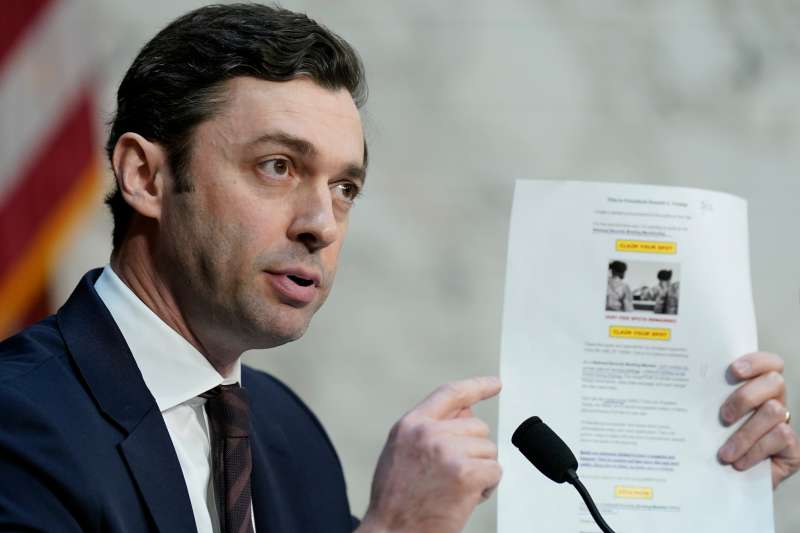
Before Jon Ossoff was the youngest US Senator in Georgia’s history, he was an investigative journalist and film producer.
His company, Insight Film, produced deeply reported stories about everything from corruption in soccer to a 23-year-old Yazidi woman grappling with the aftermath of ISIS’ sexual violence.
His instinct to investigate and demand accountability from those in power has defined his time in the Senate just as thoroughly as it did when he was a young journalist.
“It is so important, especially in times like these, that we are unearthing truths that some would like to keep hidden and bringing them into the public life,” he told Courier Georgia.
An investigative journalist in the Senate
Ossoff arrived in the US Senate in January 2021, and almost immediately became Chair of the Senate Permanent Subcommittee on Investigations. Since then, his congressional office has become renowned for subpoenaing hundreds of people for interviews, scouring thousands of pages of documents, and producing rigorous reports with an emphasis on accountability and action.
“In the oversight work and investigations that I’ve led in the Senate, like the mistreatment of military families in privatized housing or civil rights abuses and corruption in our prison system, I have drawn upon my experience in investigative journalism to inform how I’ve pursued those investigations,” Ossoff said.
His first major target was the federal prison system and, specifically, the US Penitentiary Atlanta. According to the New York Times, Bureau of Prison employees derisively described the culture at the federal prison as “the Atlanta way.” Ossoff’s congressional investigation into the facility documented widespread violence, drug abuse, and health violations.
As a result of this investigation, Ossoff and US Rep. Lucy McBath (D-Ga.) introduced the Federal Prison Oversight Act. The bill required comprehensive inspections of all 122 Bureau of Prisons facilities and created a new, independent office to investigate the safety of incarcerated people and prison staff. President Biden signed it into law in July 2024.
Ossoff has also taken aim at Georgia’s foster care system, launching extensive investigations into Georgia’s Division of Family and Children Services (DCFS). His office interviewed more than 100 witnesses and sources to produce a 64-page report that detailed pervasive abuse and neglect within DFCS.
Among the most harrowing findings was the fact that 1,790 children from Georgia were reported missing from 2018 to 2022, many of them likely victims of sex trafficking.
Last month, Ossoff released another bipartisan investigation, revealing that children around the country are being locked in juvenile detention facilities—not because they committed any crimes, but because there are no available foster care placements.
Taking on congressional stock trading
Perhaps no issue has become more synonymous with Ossoff’s brand of anti-corruption politics than his campaign to ban members of Congress from trading stocks.
The problem is not a secret. Members of Congress routinely have access to potentially market-moving information—legislation, classified briefings, regulatory decisions—that ordinary investors will never see. And for years, they have traded on it with near-impunity.
“Members of Congress are not ordinary stock traders,” said Michael Beckel, the Money in Politics Reform Director at the nonpartisan nonprofit Issue One. “Democrats, Republicans, and independents alike have been outraged by what they perceive as lawmakers coming into office and being able to trade on insider information and game the system to their own financial advantage.”
This self-enrichment has come into sharp relief on both sides of the aisle. Politicians including Nancy Pelosi and Marjorie Taylor Greene have seen their personal net worth soar while in office, far beyond typical investment returns.
Upon taking office in 2021, Ossoff placed his own portfolio into a qualified blind trust, which means he is not able to see his investments or alter them while in office. He remains only one of seven members of Congress—less than 2%—to have done so.
“There’s nothing stopping any member of Congress from following the lead of people like Senator Ossoff and putting their assets into a qualified blind trust,” said Beckel. “These types of practices help restore trust in our democratic institutions.”
In January 2022, Ossoff introduced the Ban Congressional Stock Trading Act alongside Sen. Mark Kelly (D-Arizona). The bill would require all members of Congress, their spouses, and their dependent children to place their investments into a blind trust, and would fine any violator the equivalent of their entire congressional salary. Ossoff and Kelly reintroduced the legislation in 2023 and again in May 2025.
In July 2024, the bill made history. It became the first congressional stock trading ban ever to pass a US Senate committee, clearing the Homeland Security and Governmental Affairs Committee with bipartisan support.
A House version was unveiled in September 2025 with Speaker Mike Johnson’s backing and a public statement of support from President Donald Trump himself, who told Time magazine he would “absolutely” sign such a bill.
At the same time, Trump and his personal financial advisors made more than 3,700 trades worth millions of dollars during the first quarter of 2026 alone, including with companies that are working directly with his administration. And Speaker Johnson recently backpedaled, saying that he needed to let members of Congress “engage in some stock trading so they can continue to take care of their family.”
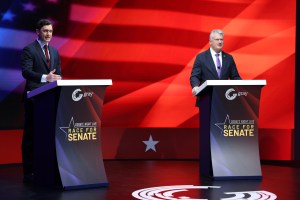
In Georgia’s Republican Senate primary debate, candidates Mike Collins and Derek Dooley signaled support for a stock trading ban. Yet Collins, while in office, has declined to place his own investments in a blind trust.
He has instead become what one article called “Congress’ most prolific crypto trader,” a practice that mirrors a broader pattern of financial self-enrichment among the Trump administration that Ossoff has made central to his 2026 reelection campaign.
Targeting corporate influence and the ‘Mar-A-Lago Mafia’
Beyond stock trading, Ossoff has challenged the corrosive impact of money in politics, from the hundreds of millions of dollars spent on election campaigns to corporate political lobbying. In 2022 and 2024, to address this, he and Sen. Kelly introduced the Ban Corporate PACs Act.
Political Action Committees (PACs) are outside groups that are allowed to spend unlimited sums on campaigns. They have become a vehicle for corporations to effectively purchase their desired policy outcomes. As Ossoff has argued, a pharmaceutical company, for example, that pours money into a candidate’s campaign has a direct financial interest in that candidate’s votes on drug pricing. His legislation would have prohibited corporations from creating PACs, barred them from soliciting donations, and dissolved all corporate PACs within one year.
Like the stock trading ban, the bill has stalled in a Republican-majority Congress that refuses to limit its own fundraising options.
Ossoff has increasingly framed these structural reform efforts within a broader indictment of what he calls the “Mar-a-Lago Mafia,” his term for the culture of self-enrichment he says has taken root during President Trump’s second administration. The New York Times has documented how Trump and his family have made hundreds of millions of dollars since returning to office, from real estate deals with foreign governments to cryptocurrency trades.
“Rent, power, groceries and healthcare have all hit all-time highs this year,” Ossoff said during a rally in Augusta in April. “While you pay more for everything, the first family’s wealth is growing by billions of dollars – because they’re crooks, and everybody knows it.”
However, Ossoff has made clear that Trump is not an aberration. Self-dealing in politics, he argues, has become the rule.
“I think Donald Trump’s rise — Donald Trump himself — is a symptom of a deeper disease in our society,” Ossoff said in February, arguing that the real problem is a system that allows corporations to purchase influence and elected officials to get rich.
Whether the stock trading ban or the corporate PAC bill translate into sweeping legislative victories, Ossoff’s career is rooted in a clear philosophy. Democracy depends on transparency, corruption thrives in secret, and the job of public servants is to serve the most vulnerable members of their constituencies—like children in foster care and incarcerated people—rather than themselves.