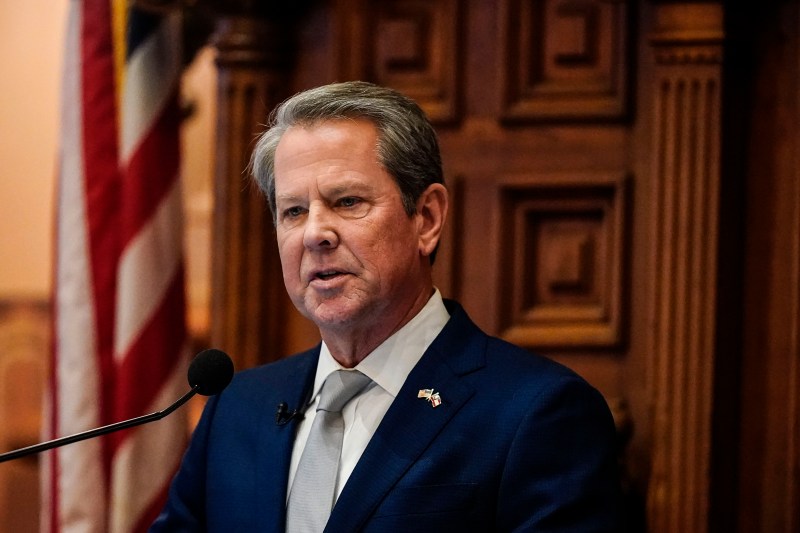
Georgia has one of the largest economies in the country. And as Gov. Brian Kemp regularly likes to tout, it has ranked the No.1 state for business twelve years in a row, according to Area Development Magazine
So why does it rank second to last in the uninsured rate when it comes to healthcare, near the bottom in child well-being, and, at least in some rankings, among the worst in the country for quality of life?
Kemp is in the final year of his eight-year tenure as governor. Before he leaves office, it’s worth taking a look at what his time in power has actually produced. Not for corporations and businesses, but for the people who actually live here.
Healthcare
Kemp has repeatedly refused to expand Medicaid, leaving Georgia as one of only 10 states that has not adopted the program. As a result, Georgia has the second highest uninsured rate in the country, trailing only Texas. Roughly 300,000 more Georgians would be eligible for healthcare if the state expanded Medicaid, according to the Urban Institute.. For many, a lack of coverage means avoiding doctors entirely or facing catastrophic medical bills when a health crisis strikes.
Even for those with insurance, Georgia can be a dangerous place to give birth. The state has one of the highest rates of maternal mortality in the country. 37.9 per 100,000 women die while giving birth or in the weeks after, and a significant portion of those deaths are considered preventable.
The situation has worsened since Kemp signed a six-week abortion bill into law in 2019. Since the law took effect in 2022, after the US Supreme Court struck down Roe v. Wade, women throughout the state have died or suffered serious complications when doctors refused to treat them during miscarriages or waited for conditions to deteriorate before providing care due to fear of legal repercussions.
In one harrowing instance, doctors kept Adriana Smith on life support for months after she was declared legally dead. Smith was nine weeks pregnant when she experienced a medical emergency. Doctors said they could not remove breathing machines until the fetus she was carrying reached viability, despite her family’s wishes.
Agriculture
Agriculture is the backbone of Georgia’s economy, but the industry is in crisis. Farmers are being squeezed from multiple directions due to a prolonged drought, tariffs, fertilizer shortages, and spiking fuel prices due to President Donald Trump’s war with Iran.
The financial toll has been severe. Last year, 162 farmers in Georgia filed for bankruptcy, the second-highest farm bankruptcy rate in the nation. But the damages go beyond profit and loss statements. Nearly 1 in 3 Georgia farmers contemplate suicide each month, according to the Georgia Foundation for Agriculture.
“Georgia farmers are facing a severe mental health crisis,” said UGA College of Agricultural & Environmental Sciences Associate Dean for Extension Michael Toews. “Resilience doesn’t mean invincibility. We need to offer listening without judging and remind farmers they’re not alone.”
Education
Georgia is home to a respected network of colleges and universities, but the picture for K-12 students, particularly outside of Atlanta, is more troubling. An analysis by The Current Georgia found that if the Atlanta Metro Area were removed from state educational attainment rankings, “Georgia’s remaining 130 counties would rank next-to-last nationally, ahead of West Virginia but behind Mississippi.”
Georgia has the third largest rural school population in the country, with more than 380,000 children attending rural schools, as of 2019. The state spends $15,833 per student, which is more than its Deep South peers, but far less than states like California and Pennsylvania.
Georgia does rank 21st in average teacher pay, but the state still struggles to recruit and retain qualified teachers, and ranks 39th in overall child and family well-being.
Cost of living and inequality
Eggs, a gallon of gas, rent. The cost of everything in Georgia has skyrocketed. The average price of a home has increased by more than 100% in the last ten years, putting homeownership out of reach for a growing share of residents. A gallon of gas in Atlanta, which cost $2.80 in 2018, is now $4.14 in Atlanta and $3.95 statewide. That same year, the average price of a two bedroom apartment in Atlanta was $1,031. Today, the average price of a two bedroom apartment in the city is $1,937.
Statewide, nearly half of all Georgians struggle to afford basic expenses like rent, groceries, and their electric bill. That figure is worse for Black Georgians: white households hold 8X the wealth of Black households.
Georgia’s minimum wage sits at $5.15 per hour, well below the federal floor of $7.25, which applies in most cases. But for tipped workers, the floor falls even lower: $2.13 per hour, leaving some of the state’s lowest-paid workers with wages that haven’t meaningfully changed in decades.
Taxes and funding
One of Kemp’s most cited accomplishments is building a substantial budget surplus and delivering tax relief to Georgians. But that relief has not been distributed evenly. Large corporations, including Meta and Amazon, have received more than $2.5 billion in incentives to encourage data center development across the state, a sum that dwarfs the benefits flowing to working families.
According to the Georgia Budget and Policy Institute, education spending has increased in Georgia from $11 billion to $38.5 billion during Kemp’s tenure. However, when accounting for new residents and the 29% cumulative increase in inflation, per-person state spending has grown at a real annual rate of just 0.2% from 2020 to 2027.
More recently, Kemp has also reduced support for school transportation and services for adults with disabilities.
Quality of life
Gov. Kemp frequently points to Georgia’s status as the No. 1 state for business as a signature achievement of his tenure. But a CNBC survey awarded Georgia an “F” grade for quality of life, citing the lack of affordable healthcare and childcare. The state also ranks near the bottom nationally in child well-being and overall quality of life metrics.
“If this is a great place to be an employer, how do we make it a great place to be an employee?’” said Tommy Pearce, executive director of the nonprofit Neighborhood Nexus.
Has your life improved or declined since Brian Kemp took office? Email me at colleen@couriernewsroom.com and let me know.