‘My feet will be so sore I can’t put any pressure on them.’
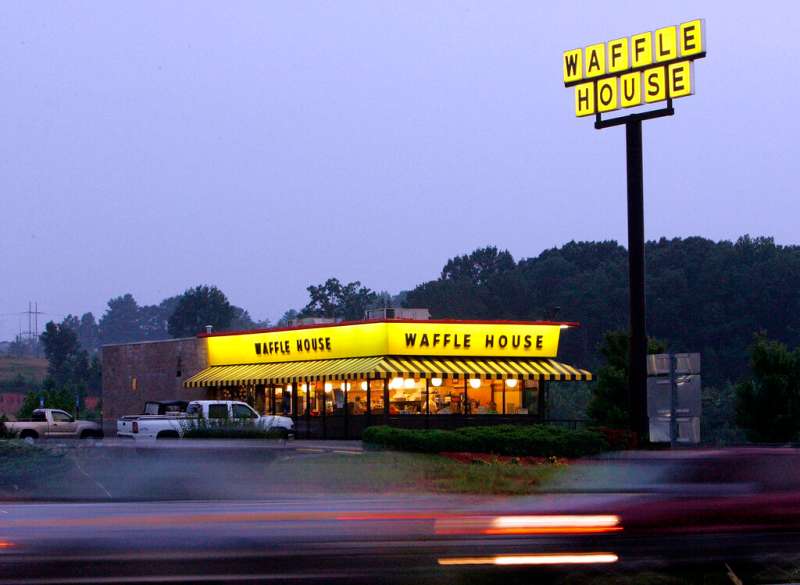
Katie Giede is a single mother in Atlanta, and she has been a server at Waffle House for almost 12 years. She works the morning shift while her son is at school, stocking napkins, refilling sugar packets, mopping floors, and cleaning restrooms after the overnight rush.
By the time she gets home, she said, “My feet will be so sore that I can’t put any pressure on them.” But she doesn’t have the option to rest for long. After a few hours, she’s back in her car, delivering for DoorDash with her son in tow.
“I do not make enough [at Waffle House] as a single mother to pay any bill in full,” she said. For all her work, Giede makes around $3.50 an hour as a tipped worker.
She is one of hundreds of Waffle House employees who have joined the Union of Southern Service Workers, which was built by and for workers across the service industry in the South. Its demands are simple: safety on the job, an end to unfair paycheck deductions, and a fair wage from the iconic Southern chain, which is headquartered in Norcross, Georgia.
A World Cup spotlight on Waffle House
Giede said the time is now to pay staff what they’re worth. Since the World Cup came to Atlanta, Waffle House’s stores and merchandise have become a sensation. The company spent thousands of dollars to renovate its downtown Atlanta location, turning it into a pop-up merchandise shop a few blocks from the stadium hosting World Cup matches. Tourists and locals alike have worn the chain’s yellow-and-black jerseys to games and watch parties.
A German fan on X described his first visit to a Waffle House in a post that has since gone viral: “Just had our first Waffle House experience at 1 a.m. Great food, great prices, and friendly staff. … 10/10, we will be coming back.”
With all that attention on the brand, the USSW is trying to redirect it toward the workers who make those 1 a.m. meals possible.
The union’s campaign against the chain dates back to 2023 and centers on three core demands: a $25-an-hour wage for all employees, 24/7 security at every location, and an end to mandatory meal deductions, which currently take roughly $3.75 out of each worker’s paycheck per shift, whether or not they actually eat.
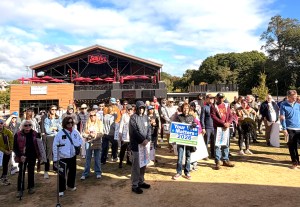
More than 500 Waffle House workers and allies gathered outside the downtown Atlanta store to draw attention to those demands during a recent protest, holding signs that read, “The whole world is watching.” They want to make sure that even as Waffle House is celebrated as a Southern icon, people understand the suffering many of the company’s employees experience.
“Waffle House stands to make enormous profits from the flood of visitors seeking late-night meals and morning breakfasts,” the union wrote on Instagram after the protest. “But the workers? Many continue to live in motels or in our cars, and work in unsafe conditions.”
‘These campaigns are about human rights.’
Matthew Hild, a history professor at Georgia Tech, said low wages and unpaid labor have been fundamental to the Southern economy since its inception including, of course, chattel slavery and the violent exploitation of enslaved Africans.
Despite the brutality of the conditions they face, Southern workers have continued to organize and fight back. Sharecroppers in the Southern Tenant Farmers’ Union organized across racial lines in the 1930s, and Black industrial workers helped build the CIO’s Southern organizing drives in the 1930s and ’40s, laying groundwork that later fed into the civil rights movement.
Hild said much of that organizing work was met with violent opposition, including during the 1934 textile strike, when mill workers walked out to demand better wages and conditions. In Georgia, Gov. Eugene Talmadge responded by declaring martial law and mobilizing roughly 4,000 National Guard troops. Strikers were rounded up and held in makeshift detention camps. Hundreds of workers were confined that way, some for weeks.
Still, Hild said, movements across the South—from abolition to the civil rights era—have long understood that workers’ rights and human dignity are inextricably linked. He pointed to the Rev. Martin Luther King Jr., who was in Memphis, Tennessee, marching alongside striking sanitation workers carrying signs that read “I Am a Man” when he was assassinated in 1968.
“These campaigns are about more than just wages,” Hild said. “They’re about human rights.”
‘We are just asking for a seat at the table.‘
That same sense of dignity is what workers like Giede say they’re fighting for today. They want to feel safe in workplaces that never close, and they want to earn enough from full-time jobs to spend time with their children.
“We are not standing up and speaking out because we hate [Waffle House],” Giede said. “We are here because we love this company and we want to see it thrive the way you say it does. We are just asking for a seat at the table.”