
Jean Kesinger has lived in Henry County since 1997, when she moved there, like many others, for the rural life it promised. Five homes surround hers, each perched on several acres, marked by the call of roosters in the morning and country silence at night.
In late 2023, a zoning notice went up that piqued the neighbors’ interest. At a public meeting, Kesinger learned that one of her neighbors was moving forward with a data center on his family’s land.
Kesinger and her neighbors were immediately concerned. A pancreatic cancer survivor, she said she is keenly aware of the environmental toll unchecked development can take.
“You don’t take a thief and put him in a bank,” she said. “Health matters.”
After they went home and reviewed the proposal documents, they learned that the neighbor tied to the data center project was state Sen. Brian Strickland, now the Republican nominee for Georgia attorney general. He faces Democrat Tanya Miller in November.
The project on his family’s land has since drawn ire from Henry County residents and officials in nearby Hampton.
Yet on the campaign trail, Strickland has said local governments should “listen to constituents about where these data centers go, which counties want to have them, which communities don’t want to have them.”
Residents in Henry County say they’re not being heard as dozens of data center projects emerge in their area, potentially threatening their water supplies, their property values, and the rural way of life they have embraced for generations.
“It’s impossible for us not to stand up and do whatever we can do. We’re not tree huggers. We’re people who want to live a life as healthfully as possible, as peacefully as possible,” said Kesinger, who identifies as a Republican.
‘You took away what I bought’
In the first half of this year, the Atlanta area passed Northern Virginia in data center capacity under construction for the first time, according to the real estate firm CBRE. As proposals have multiplied south of Atlanta, residents say they feel betrayed.
Anne Fields moved to Henry County in 2022 and says she paid “top dollar” for a home surrounded by forests that teemed with life. Now, with housing construction and data centers being proposed throughout the area, she says the county is siding with developers over residents.
“You took away what I bought,” she said.
Fields said she’s surprised that Strickland, whose family has lived in the area for generations, would rush to join the data center boom rather than shepherd the land his family has called home for so long.
During his campaign, Strickland has repeatedly pointed to his agricultural upbringing as the root of his work ethic and public service.
“The values of the farm that I take to the Capitol every single day are integrity, hard work, and stewardship,” he has said.
In a September op-ed in the Atlanta Journal-Constitution, Strickland wrote that he grew up on one of the last row crop farms in Henry County and watched his parents take on the local government when it used eminent domain to take parts of the family’s land.
“That experience planted the seed for a career in the law so that I could give voice to those who deserve a fighting chance,” he wrote.
Now it’s his neighbors who are worried about what will happen to the land around them.
Strickland has been asked about data centers on the campaign trail. In an August interview with 11Alive, he said local governments should decide where data centers go and acknowledged that they’re “not for everybody.” He said the attorney general’s job is to make sure approved projects follow environmental law and protect Georgia’s waterways. “Is it going to affect our drinking water?” he asked.
He also mentioned the financial windfall of data center development. “There’s a lot of money that comes with data centers,” he said. Strickland did not mention his own stake in a data center project awaiting approval in his home county.
The ‘Strickland Tract’
The project, known in state filings as the “Strickland Tract,” proposes a development totaling roughly 1.25 million square feet on a 250-acre site along Strickland Road. The project’s estimated value at buildout is $1.2 billion. The developer is Red Wolf DCD Properties, which has been tied to other controversial data center projects in Georgia.
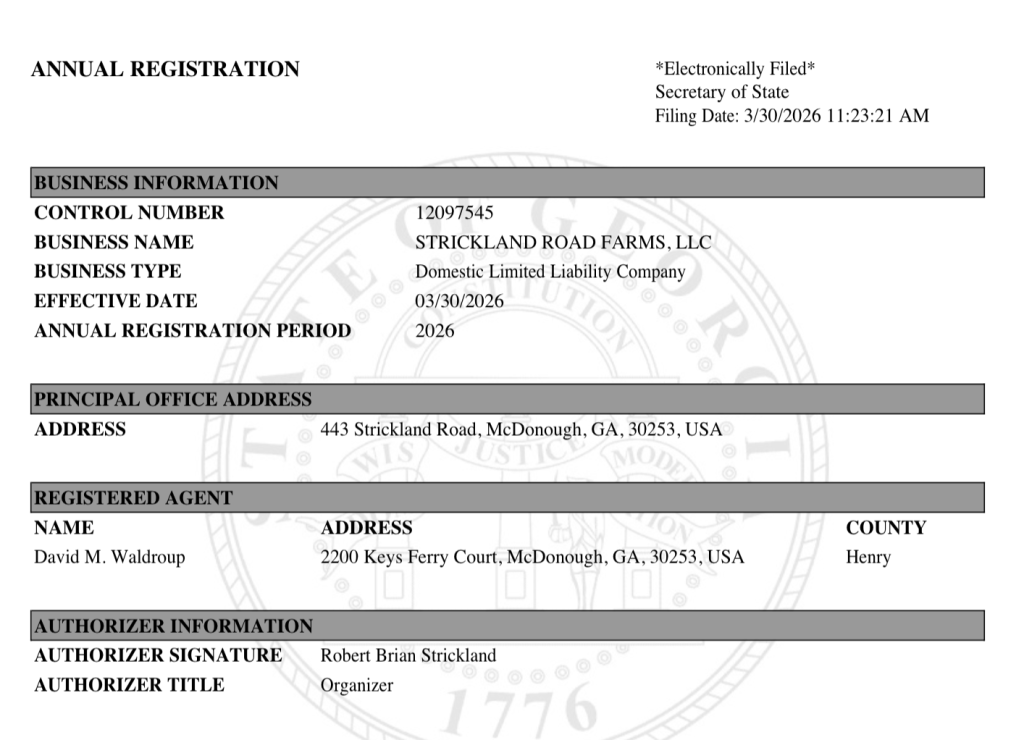
Strickland Road Farms, LLC is listed as an applicant and owner of the underlying property.
In Strickland’s personal financial disclosure forms, he lists himself as a member of Strickland Road Farms, LLC, with an ownership interest of more than 5%.

The LLC’s most recent annual registration with the Georgia Secretary of State lists him as the organizer who filed it.
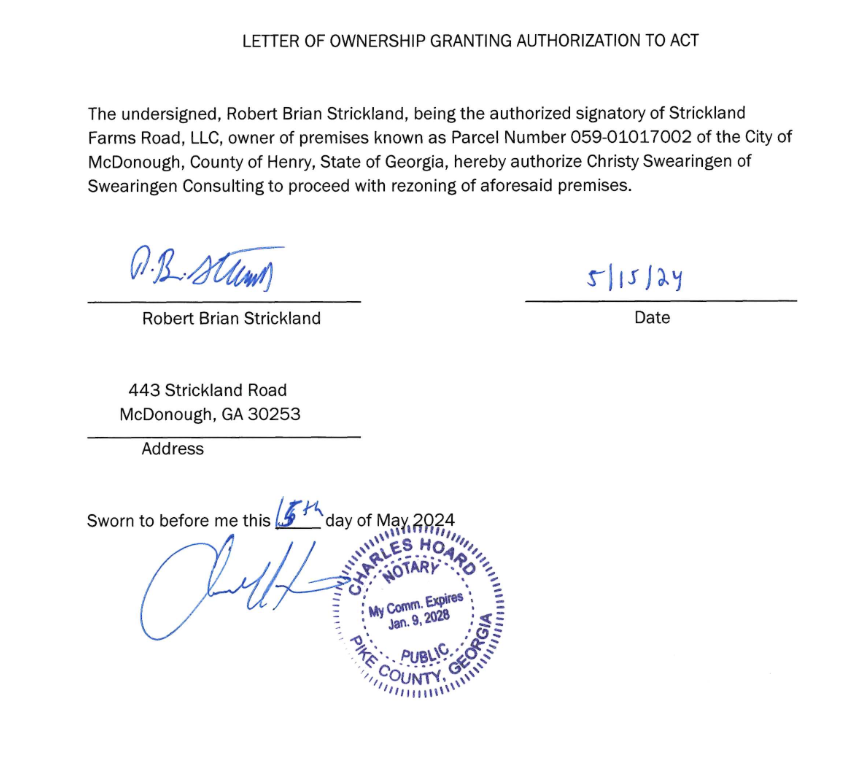
According to records obtained by Courier Georgia, Strickland also personally participated in advancing the data center project. In May 2024, he signed a notarized letter authorizing a data center consultant to move forward with the rezoning.
The project has cleared nearly every hurdle along the way. A state transportation authority approved the potential use of public funds for road improvements to the site, and county staff recommended conditional approval. Only a final vote of the Henry County Commission remains.
That vote was scheduled for June 17, 2025, exactly two weeks after Strickland announced his campaign for attorney general. Instead of going forward, the items were “removed by the applicant.” The commission chair said they would be heard at a later time, and the application remains completed—not withdrawn—on Georgia’s official site of Developments of Regional Impact.
As of this writing, neither Strickland’s campaign nor Red Wolf DCD Properties had responded to requests for comment.
Water concerns
When the project went through review in September 2024, the City of Hampton raised concerns about the development, noting that the proposed site falls within two watershed protection areas. The city also pointed to county rules requiring spill and leak containment for facilities that handle hazardous materials.
The Atlanta Regional Commission flagged problems, too. Its preliminary review found the project out of step with regional policies that call for preserving critical environmental resources, farmland and forest in developing suburbs like this corner of Henry County.
Fletcher Sams, executive director of the Altamaha Riverkeeper, said the project sits on a ridge between two waterways that are part of the Source Water Protection Plan. These are protected areas that supply drinking water to the surrounding communities.
Sams says he has never seen a warning of this kind from a municipality about a proposed data center. It raises serious concerns about threats to the water supply, he said, including whether glycols, PFAS, or other additives could end up in the water.
“We would know if we had transparency,” he said. “Data centers don’t belong everywhere.”
He says that lack of transparency raises serious questions about Strickland’s role as attorney general, an office that is supposed to represent the people in their fights against powerful corporations and special interests.
A potential conflict of interest
Sams wasn’t alone in his concerns. Kendra Sutherland, who is restoring an old Victorian home in Hampton, opposes the data center development. She believes Strickland’s investments would keep him from taking the side of residents, or of Georgians more broadly, in data center disputes.
“How can you be objective when you clearly have a position on the matter?” she asked. “He’s the lawyer for developers.”
Those disputes could land on the attorney general’s desk. As Strickland himself has pointed out, the attorney general’s office is the lawyer for the Georgia Environmental Protection Division, which means it represents the state in enforcement actions against companies accused of breaking Georgia’s environmental laws.
The office also has the power to enforce Georgia’s Open Records and Open Meetings acts, and it runs a mediation program that helps residents get access to public records and meetings. That role carries new weight in the data center debate, where secrecy has become a flashpoint.
In September, a conservation group and Effingham County residents sued local officials, alleging they broke the state’s open government laws while negotiating an OpenAI data center deal under a nondisclosure agreement. State lawmakers also introduced bills this year to bar local governments from signing nondisclosure agreements about data centers’ water and electricity use.
‘Everything we do impacts our neighbors’
Kesinger and Fields say that if you scan the comments on Facebook or talk with residents, you’ll find a common thread: no one wants to lose the productive farmland that has defined Henry County for generations.
And they want a say in what happens in the neighborhoods where they have bought homes and decided to raise their families.
“Everything we do impacts our neighbors,” said Fields. She wants data center developers to remember that.