In Gainesville, a city known as the “poultry capitol of the world,” hundreds of immigrants spend their days inside chicken processing plants, their hands raw from stripping feathers and skin off carcasses.
Alongside chicken, the city has long been a site of industrial development—and the pollution, health risks, and neglect that came with it. In response, grassroots groups have organized for decades, demanding accountability and real protections for the city’s working-class residents.
Among these groups is the Rainbow Collective, a queer-led organization in north Georgia that has become an unlikely force against the data center boom and, most recently, the machinery of immigration enforcement expanding alongside it.
The group takes its name from the Rainbow Coalition, the multiracial alliance the Black Panther leader Fred Hampton built in Chicago in 1969, uniting the Panthers, the Puerto Rican Young Lords, and the white, working-class Young Patriots around shared economic pain.
Six decades later and about a thousand miles south, the Rainbow Collective is building a queer- and trans-led, multiracial coalition organized around the economic pressures facing working people in Georgia.
A major test came late last year, when word spread that a $1.2 billion, 119-acre data center known as Project Turbo was being proposed in the community. But eventually, the developers decided to walk away—a victory local organizers say was driven in large part by the Rainbow Collective.
A data center next door
The data center was slated to be built just blocks from a mobile home park home to many of the area’s immigrant families. When Rainbow Collective members began knocking on doors there, they found that most residents had never heard of the project, and many did not know what a data center was in the first place.
Matéo Penado, chairman of The Rainbow Collective, described his approach to speaking with residents.
“If I can effectively communicate this to my parents, then I know I can effectively communicate this to another community member,” he said. Both of his parents were immigrant workers in Gainesville’s chicken processing plants.
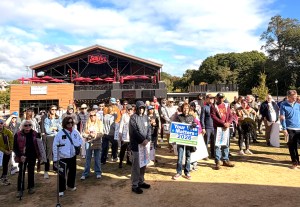
Volunteers also built social media campaigns to draw attention to County Board of Commissioner meetings—where the data center proposal would be reviewed—and set up tables with games for children at community festivals and events. It was a way, Penado said, to hold parents’ attention long enough to talk with them about the data center fight while their children played nearby.
The strategy worked. Commission meetings on the proposal were packed. Some residents raised concerns about the project’s likely strain on Georgia’s water resources.
The Rainbow Collective argued that data centers were another example of the environmental racism that had long defined the city’s history.
In 1936, a tornado tore through Gainesville and devastated a predominantly Black neighborhood. Survivors were relocated to a small settlement called Newtown, though residents were not told at the time that their new homes sat atop a former landfill.
In the decades since, Newtown has been ringed by industrial facilities, including a Purina feed plant, and residents have reported elevated rates of respiratory illness and cancer. For many in Newtown, Project Turbo looked like another chapter in a long history of environmental burdens disproportionately placed on their community.
An unexpected win
After months of tireless organizing and coalition-building, the developers withdrew their proposal. Media reports cited the sustained community opposition as a reason why.
“I’m very happy they pulled the plug,” said Kerri McCoy, who lives in the area, at the time.
Penado attributes the win to the coalition’s ability to hold together across differences. Residents’ objections to the project, he said, “may vary from economic to humanitarian to cultural,” but added that “they are ultimately concerned about how this is going to impact people and their fellow communities.”
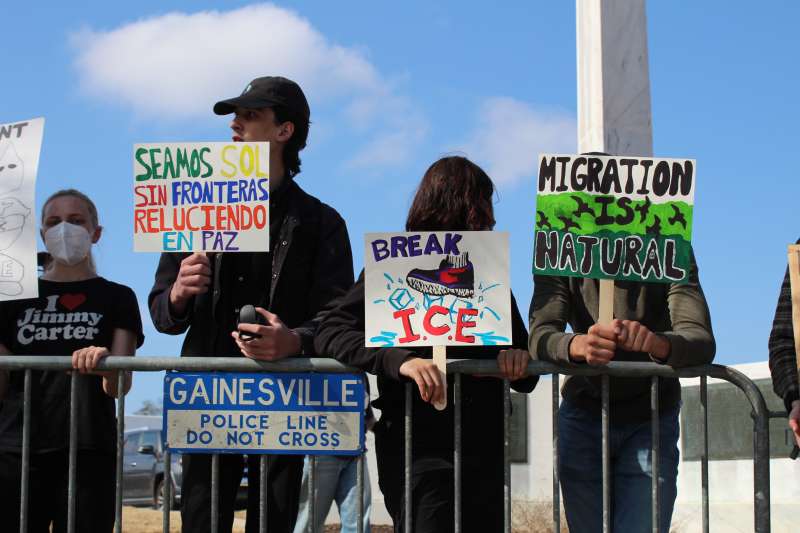
The coalition’s momentum did not fade with the data center’s defeat. A few months after developers withdrew Project Turbo, the Department of Homeland Security announced plans for a new ICE detention facility in nearby Oakwood. This time, the Rainbow Collective was ready, returning to the same playbook of door-knocking, community events, and one-on-one conversations with neighbors.
They’ve linked the fight against ICE to the fight against data centers. The Rainbow Collective argues that data centers, built to power the artificial intelligence (AI) boom, are increasingly bound up with the infrastructure of immigration enforcement. Companies like Palantir have won lucrative contracts with Immigration and Customs Enforcement to build AI-powered surveillance systems, a prospect The Rainbow Collective says is especially alarming in a city with as large an immigrant population as Gainesville’s.
Earlier this month, DHS paused a similar detention facility proposal in Social Circle. The New York Times has reported the ICE facility closures were driven in part by fierce local opposition and a wave of environmental lawsuits filed against such facilities nationwide. Many Oakwood residents now hope their community will be next to see its own proposal shelved.
A model for other communities
Penado said he hopes the Rainbow Collective’s success offers a template and a measure of hope to grassroots organizers elsewhere who may feel that entrenched interests have already decided the outcome before the fight begins.
“People have said the government officials have already made up their minds,” he said. “But we’ve shown them again and again that that is not the case.”
His advice to other organizers is simple: Invest in relationships first.
“We don’t have to struggle in the struggle,” he said.