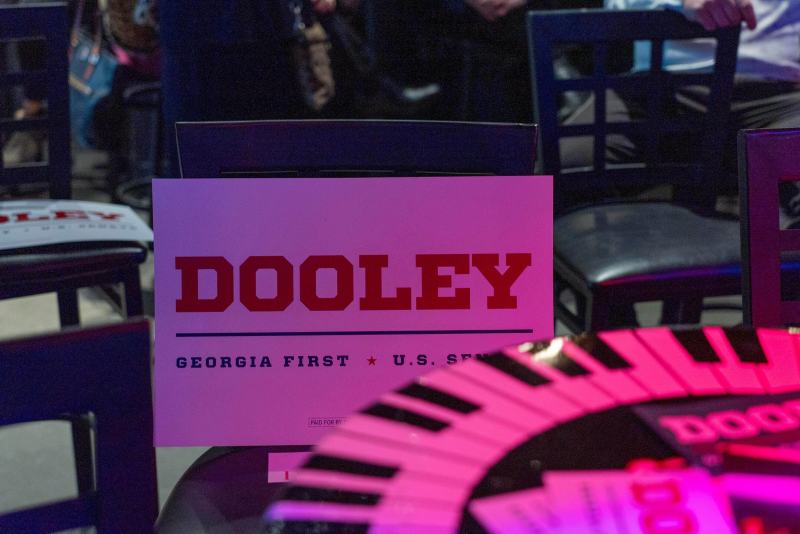
A nonpartisan, independent watchdog group told Courier Georgia they would support a formal investigation into the relationship between Gov. Brian Kemp (R) and his childhood friends, US Senate candidate Derek Dooley, and Derek’s brother Daniel Dooley, the founder of school safety company Centegix.
Dylan Hedtler-Gaudette, acting vice president of policy and government affairs at the Project On Government Oversight (POGO), says the web of financial and political ties between the Dooley and Kemp families raises serious concerns about how public money has been spent in Georgia.
POGO is a Washington, DC-based nonprofit that has investigated government corruption and abuse for more than four decades. After reviewing the publicly available details of the Centegix contracts, Hedtler-Gaudette said the situation has enough “red flags” to warrant independent scrutiny.
“I would absolutely hope that a state entity of some kind—maybe it’s the Georgia inspector general, maybe it’s a law enforcement agency—would be looking into this,” he said.
The Centegix scandal
The growing questions center on the relationship between Georgia’s public schools and Daniel Dooley’s company, Centegix.
According to a report by 11Alive, in October 2018, Daniel Dooley launched a small startup called Centegix that sold wireless panic buttons to school districts. The devices are designed to allow teachers and staff to quickly alert law enforcement during emergencies.
Within months of taking office, Kemp moved in a direction that would prove extraordinarily profitable for Dooley’s fledgling company. In the spring of 2019, Kemp authorized a $30,000 security grant to every public school district in Georgia.
Dooley’s company made millions of dollars from those purchases almost immediately.
The governor’s support didn’t stop there. During his first year in office, Kemp held multiple official meetings with the Georgia School Superintendent Association (GSSA) and called the product “very simple but very effective.”
The relationship continued to deepen in the years that followed. In 2025, Kemp signed SB 17 into law. That legislation required all public elementary and secondary schools in Georgia to be equipped with mobile silent panic buttons that connect directly to law enforcement. The law effectively made the kind of product Centegix sells a statewide mandate.
The market impact was swift and sweeping. In August 2025, after the law took effect, WSB-TV reported that 90% of all Georgia schools were using Centegix warning systems. In total, Daniel Dooley’s company has received more than $27 million in Georgia taxpayer dollars.
The impact of politics
In August 2025, a new and potentially more troubling layer emerged. Derek Dooley—Daniel’s brother and the former University of Tennessee head football coach—announced his campaign for the US Senate.
Kemp quickly endorsed him.
Shortly after, it was revealed that Daniel Dooley had donated more than $100,000 to Kemp’s political action committee (PAC), Hardworking Americans Inc. The PAC is currently directing extensive support toward Derek Dooley’s Senate campaign.
The timeline has drawn sharp attention from Democratic lawmakers in Georgia. A governor promotes and then mandates a product made by one brother’s company, that brother then donates six figures to the governor’s PAC, and the governor uses that PAC to back the other brother’s political campaign.
No-bid contract concerns have also surfaced. Watchdog groups have questioned whether Centegix received favorable treatment that bypassed competitive procurement processes that normally govern how taxpayer money is spent.
Worse outcomes
Beyond the ethical questions, Hedtler-Gaudette says that cronyism—giving favors to friends and allies rather than selecting vendors on merit—carries real-world costs for the public.
“It is a moral and ethical outrage, but it’s also a bad way to conduct public policy, and it’s a bad way to be good stewards of public resources,” he said.
Even if Centegix’s panic buttons have provided genuine value to Georgia schools, the process by which the company came to dominate the market matters. There may have been other companies offering more effective technology at a lower cost. Without a transparent and competitive bidding process, there is no way to know.
Hedtler-Gaudette said the use of “taxpayer dollars should be as clean, efficient, effective, and transparent as possible.”
The growing call for an investigation
Hedtler-Gaudette’s call for an investigation joins a growing chorus of elected officials demanding accountability.
This month, Georgia lawmakers have requested that Kemp open an independent investigation into the state contracts involving Centegix and the campaign finance activity surrounding the company.
State Rep. Shea Roberts, a Democrat, was direct in her demand at a recent press conference.
“Georgians deserve to know the truth, and they deserve it now,” Roberts said. “That’s why today, alongside, with my colleagues from the House and Senate, we are announcing that we have signed a statement demanding Governor Kemp open an independent investigation into Centegix and no-bid contracts during this month’s special session.”
In a response, Gov. Kemp’s office rejected the allegations.
“In a new low, Georgia Democrats are now attacking $520 million in locally-controlled school security funding that protects students, teachers, and faculty—and ultimately saves lives,” a Kemp spokesperson said in a statement to CBS News.
For now, the call for an independent investigation remains unanswered.