The battle between Sen. Chuck Schumer (D-NY) and Sen. Chris Van Hollen (D-Md.) over who will lead Senate Democrats into their new majority has reached the Peach State.
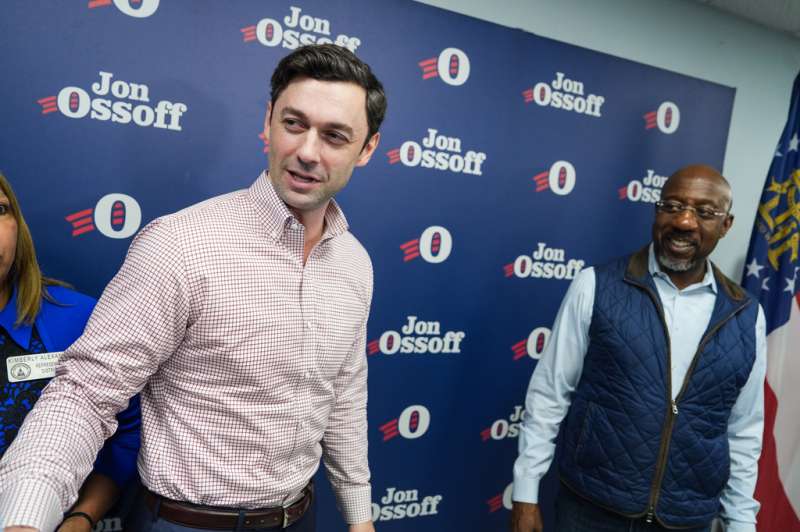
This week, Sen. Jon Ossoff (D-Ga.) joined a growing number of senators who say they are not ready to back either candidate for majority leader. His office had declined to comment on the race last week, but Ossoff has since signaled he is keeping an open mind.
“I want to hear from any candidate what their vision is for the floor and managing the caucus,” Ossoff said.
Georgia’s other senator, Raphael Warnock (D-Ga.), struck a similar tone last week. Warnock credited Schumer with running an effective campaign operation this cycle, but said challengers deserve a chance to make their case.
“I think we’re at an inflection point in our country. The voters are demanding that we stand up and fight for them, and so any member of my caucus that feels like they should lead in this moment, I look forward to hearing their case,” he said.
The fight broke into the open after Democrats’ sweeping win in the Nov. 3 midterms, which gave the party a 56-seat majority in the Senate, including Sens. Bernie Sanders (I-Vt.) and Angus King (I-Maine), who caucus with Democrats.
Much of Van Hollen’s energy comes from the incoming class. Several newly elected senators, including Sen.-elect Abdul El-Sayed (D-Mich.), Sen.-elect Peggy Flanagan (D-Minn.) and Sen.-elect Adam Hamilton (D-Kan.), have backed Van Hollen or called for a change in Democratic leadership.
“[Van Hollen] is a great balance between the generational change we’re asking for in leadership, but also someone who’s been in and around the Senate and the House to understand how to shepherd legislation,” El-Sayed said.
A restless electorate
Many voters also entered the midterms wanting a shake-up. An AP-NORC poll conducted in October found that 80% of registered voters wanted either “complete and total upheaval” or “substantial change” in how the country is run. Roughly one-third chose upheaval, and another 47% wanted substantial change.
That frustration cut across both parties.
Trump’s approval rating stood at 36%, while only 40% of voters viewed the Democratic Party favorably. A separate YouGov poll found that just 22% of respondents held a “very favorable” or “somewhat favorable” view of Schumer.
Senators say their offices have been flooded with calls from constituents urging them not to support Schumer, and progressive groups have circulated the Capitol switchboard number to encourage more.
Meanwhile, allies of Schumer told The Hill on Sunday that he expects to receive at least 40 votes. They cast Van Hollen’s bid as an effort to extract concessions on progressive priorities such as Medicare for All and ending the filibuster.
What comes next
For Ossoff and Warnock, the decision carries weight beyond the caucus. Georgia’s two senators helped hand Democrats their last Senate majority in the January 2021 runoffs, and their choice will be read as a signal of where the party’s swing-state wing stands.
Both Van Hollen and Schumer are expected to keep courting undecided senators in the coming weeks. The caucus will settle the question when it meets behind closed doors on Dec. 1.