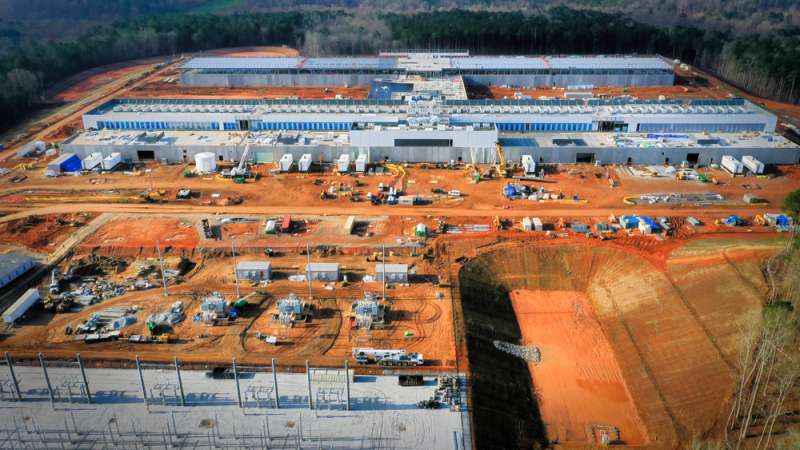
The debate over OpenAI’s proposed $20 billion data center campus in Effingham County is about more than a high-stakes economic development deal for many local residents.
Neighbors have raised concerns about the data center’s potential impact on their schools and homes, as well as a lack of transparency during the planning and approval process.
“As Effingham residents, we have been kept in the dark,” Manjusha Sheobaran, who lives less than 1000 yards away from the building site, said in a statement. “When a controversial development threatens our quality of life, natural resources, or tax base, the matter goes beyond county officials’ desires.”
Sheobaran is one of five residents who live within a mile of the site, along with the coastal Georgia nonprofit One Hundred Miles (OHM), suing the Effingham County Industrial Development Authority (ECIDA) and Octans GA, LLC over the approval of Project Camellia, a planned OpenAI-affiliated data center campus at the Savannah Gateway Industrial Hub.
In the lawsuit, they raise concerns that construction and operation could increase flooding risks, bring years of noise and affect air quality near their homes and nearby schools.
“This massive project will impact Effingham County’s neighborhoods, schools, water use, and power bills for years to come,” Megan Desrosiers, president and CEO of OHM, said in a statement. “Residents deserve to know the facts and the ability to weigh in with a meaningful voice before decisions are finalized.”
The lawsuit also alleges ECIDA violated Georgia’s open meetings and open records law while advancing the project. Under Georgia’s Open Meetings Act, an agency may discuss a real-estate transaction in executive session, but the vote is not binding until a subsequent public vote identifies the property and discloses the terms of the transaction. The Open Records Act requires public records to be available for inspection and copying, unless a specific legal exemption applies.
The plaintiffs alleged the public was not properly notified before a July 21 meeting—originally scheduled for July 16—when the authority approved an agreement with Octans GA LLC, identified in project documents as an OpenAI affiliate, and authorized documents tied to a land transfer. The allegations have not been proven in court.
Approval process challenged
In a statement from OpenAI, the company said it plans to contract with Georgia Power for 3.2 gigawatts of power, delivered in phases between 2028 and 2032. The campus would cover about 1,440 acres and include 4.4 million square feet of buildings and supporting infrastructure, according to project documents and the lawsuit. The signed memorandum of understanding estimates at least $20 billion in cumulative investment and sets a minimum cumulative goal of 400 full-time jobs across five phases.
The plaintiffs argue in the lawsuit that the authority’s July meeting agenda did not make those stakes clear. In an email sent at 10:24 a.m. on July 16, ECIDA Office Manager Debbie Trowell said the regularly scheduled meeting of the authority that day was rescheduled to July 21. A second email, sent at 4:40 p.m., included an agenda listing “Discussion regarding Project Gateway, including a Memorandum of Understanding.” The agenda did not identify the item as a proposed OpenAI-affiliated data center. The development of Project Camellia was announced the following day.
The lawsuit also challenges the authority’s meeting notice, executive session discussion, and handling of documents associated with the land transfer.
“Georgia’s public process rules exist because communities should not learn about major decisions only after deals have been negotiated behind closed doors,” Zachary Henneesee, a staff attorney with the Southern Environmental Law Center, said in a statement. “The Effingham County Industrial Development Authority must follow the law and give the public a real opportunity to be heard.”
ECIDA’s account, OpenAI’s commitment
The authority offers a different account of the process. ECIDA said confidential negotiations are common when companies weigh potential sites and that this did not mean the project was handled through a closed process. They claimed that once the project became viable, county and school leaders were included in the process. These leaders researched and reviewed the proposal, ultimately offering support for moving forward, the authority said.
ECIDA also said the project requires further review, including agreements and approvals related to water, sewer service, stormwater, site plans, and building permits.
In an OpenAI press release, the company pledged to cover the full cost of infrastructure and electric service needed for the campus, arguing that the project will not raise electricity rates for other Georgia Power customers. The company also said the facility would reduce its power use during periods of high demand before residential customers are affected.
The campus is expected to use a closed-loop cooling system that recirculates water rather than continuously withdrawing and discharging it. OpenAI characterized its ongoing water needs as comparable to “an ordinary workplace setting” in an office building.
Project documents and WTOC reporting set domestic water and sewer use at no more than 30,000 gallons a day, or 30 gallons per employee per day. That limit is separated from the one-time fill of the planned closed-loop cooling system, which ECIDA states would be scheduled under agreed upon conditions, including restrictions on timing and maximum daily volume.
The company also announced it will commit $80 million in community benefits over the project’s life, directing the money toward “local priorities such as schools, public safety, healthcare, utilities, workforce training, housing, veterans’ services, and support for small businesses and working families.” OpenAI stated that it plans to conduct public audits of those commitments.
But for Sheobaran, Amy and Robert Collins, Elizabeth Fisher, and Crystal Hayes, the promised benefits do not resolve the central issue in the lawsuit.
Sheobaran said for decades, the property across from residents’ homes has “suffered under the curse of the IDA’s administrative overreach, from land grabs to secret agreements.”
“Our community must have a voice in any major decisions that directly impact our families and neighbors,” she said in a statement. “It’s time for the IDA to follow the law requiring a transparent, open process.”