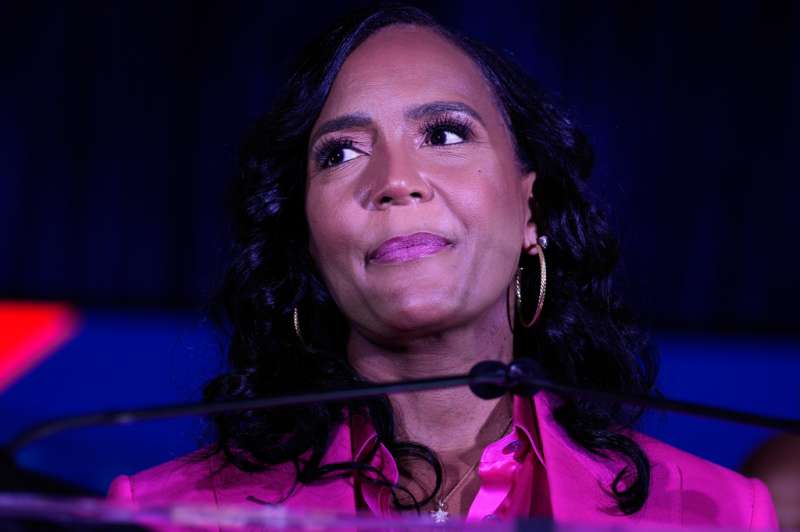
It’s been six days since Keisha Lance Bottoms won Georgia’s race for governor, overcoming more than $200 million in spending by Republican billionaire Rick Jackson to become the first Democrat elected to the office since 1998 and the first Black woman ever elected governor of a US state. She hasn’t slowed down.
Less than three days after her victory, Bottoms stood on the steps inside the state Capitol to unveil “Georgia’s Promise,” a transition team whose members include Home Depot co-founder Arthur Blank and filmmaker Tyler Perry.
“Now the work begins,” she said.
Additionally, she has started to lay out how she plans to deliver on three of her signature campaign promises: expanding Medicaid, pausing new data center construction, and repealing Georgia’s six-week abortion ban.
She will pursue that agenda with the full powers of the office.
For months, there was speculation that Republicans would use a lame-duck special session to curb the incoming governor’s authority. But Gov. Brian Kemp (R) put that to rest, announcing he would not call lawmakers back to “curtail executive branch powers” or redraw the state’s political maps. Georgia’s governor holds broad authority, including a line-item veto over the state budget.
What she won’t have is a friendly legislature on both sides of the Capitol. While Democrats flipped the state House for the first time since Republicans took control in the 2004 elections, Republicans retained the state Senate with a 29–27 majority. Because of that, every major Democratic priority will need at least a few Republican votes. Democrat Josh McLaurin, the lieutenant governor-elect, will preside over the chamber.
Here’s where Bottoms’ top priorities stand.
Preparing to expand Medicaid on ‘Day One’
Throughout the campaign, Bottoms said expanding Medicaid, the joint federal-state health program for low-income people, would be her “day one” priority.
But she can’t do it alone. Georgia law strips the governor of the power to expand Medicaid unilaterally, so the legislature must sign off.
During a press conference last week, Bottoms said she would work with legislators to find a way to pass expansion. Asked whether it could clear a divided legislature, she said: “I’m an optimist. I think it will get done.”
There are some signs of movement.
In recent legislative sessions, top Republican leaders held bipartisan hearings on the costs and benefits of full expansion, though expansion bills have never reached a floor vote. Supporters argue expansion would help stabilize struggling rural hospitals, improve maternal health, and reduce the cost of uncompensated care that gets passed on to insured patients.
Pausing new data centers
The debate around data centers produced one of the sharpest contrasts of the gubernatorial race. Bottoms called for a temporary statewide pause on new data center construction to study their effects on electricity bills, water supplies, and surrounding communities. Jackson said local communities should decide. He also faced scrutiny over a proposed nearly 600-acre data center project in Bowie County, Texas, by a firm linked to him, as first reported by Courier Georgia.
It was one of the major bipartisan issues that drove voters to the polls, and likely contributed to Bottoms’ victory.
Now she has to turn the pledge into policy. In an interview, Bottoms said she would sign an executive order pausing new data center construction, a moratorium that could last from a month to six months or longer. Her administration would then determine whether, and how, the pause could legally be extended.
“I don’t think we’re going to get a lot of pushback,” she said, noting that local governments across the state have already moved to pause construction.
If she follows through, Bottoms would join a growing list of governors in both parties who have moved to rein in the industry. New York Gov. Kathy Hochul, a Democrat, ordered a one-year moratorium on large data centers in July, and Texas Gov. Greg Abbott, a Republican, has paused state permits while his state reviews grid and water impacts.
Bottoms may also have a new ally on energy costs. Democrats won control of the Public Service Commission, which regulates utilities including Georgia Power, for the first time in decades.
Repealing Georgia’s six-week abortion ban
Bottoms campaigned on repealing Georgia’s abortion law, known as the LIFE Act. It passed in 2019 and took effect in 2022 after the US Supreme Court’s Dobbs decision overturned Roe, which had protected abortion access until fetal viability, around 24 weeks. Georgia’s law bans most abortions after about six weeks of pregnancy, before many people know they are pregnant.
On the campaign trail, Bottoms highlighted the stories of women who died after being unable to get timely care. Among the most widely cited are Amber Thurman and Candi Miller, two Georgia mothers whose 2022 deaths after complications from medication abortion were reported by ProPublica.
Repeal may be Bottoms’ steepest climb. Georgians remain deeply divided on abortion, and the Senate’s Republican majority is unlikely to take up a repeal on its own. Still, Bottoms said at Friday’s press conference that if Democrats “see a pathway” when the legislative session opens in January, they will “take that opportunity.”
There is at least one precedent. In 2024, Arizona’s Democratic governor, Katie Hobbs, signed a repeal of the state’s 1864 near-total abortion ban after a handful of Republicans joined Democrats, who were in the minority in both of the state’s legislative chambers. A Georgia repeal would be the first rollback of a modern six-week ban since Dobbs and a major test of whether the post-Roe restrictions passed across the South can be undone through the legislature.