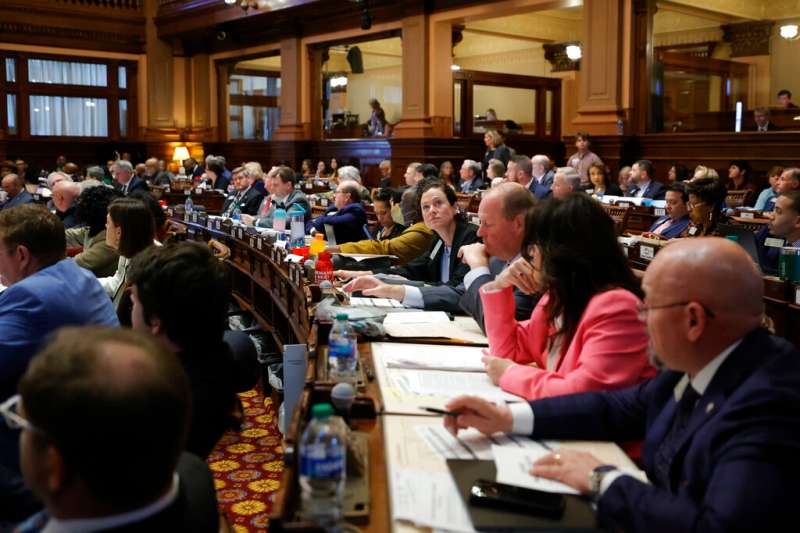
In mid-June, politicians and civil rights leaders gathered at the Georgia state Capitol, bracing for what could have been one of the most consequential legislative sessions in years. Republican Gov. Brian Kemp had called a special session to redraw Georgia’s district maps, weeks after the US Supreme Court gutted a key section of the Voting Rights Act. Kemp’s move could have given Republicans more favorable districts ahead of the 2028 election.
Instead, Republican leaders rejected the effort. “Changes to Georgia’s maps should take place only when members of the General Assembly and citizens have been given ample opportunity to gather the facts, provide input, and engage in meaningful discussion,” Georgia House leadership explained.
But Democrats say the reprieve won’t last. They expect Republicans to try again after the midterms, and they say winning the state House in November, something they haven’t done in more than two decades, would give them leverage to push back.
Democrats need a net gain of 10 seats to reach the 91 needed for a majority in the 180-member chamber, and they say they are feeling confident about their chances.
Why are Democrats feeling confident about gaining control of the state House in 2026?
Midterm elections are often a repudiation of the party in power, allowing the opposition to pick up seats in both federal and state races.
State Rep. Shea Roberts (D-Atlanta) points to President Donald Trump’s low approval rating as one reason Democrats feel optimistic this cycle. A Marquette Law School national poll found Trump’s approval fell to 37% in September, a second-term low.
Roberts also points to the galvanizing effect that the redistricting fights had on the Democratic base in Georgia.
“30% of the electorate that came out in the Democratic primary had not voted in the last three primaries. I truly believe it was because of the Callais decision,” she said, referring to the Supreme Court’s April 29 ruling in Louisiana v. Callais, which gave states the green-light to draw racially gerrymandered maps.
Roberts said she is encouraging Democratic state House candidates to reach out to those voters and listen to their needs and concerns because they could determine who controls the House during the 2027 session.
As Melody Oliphant, executive director of the Georgia Youth Justice Coalition (GYJC), pointed out, “in 2024, the three closest state House races were decided by 48 votes, by 80 votes, and by 251 votes.” For Democrats to win the majority, she said, turnout has to be their top priority.
Both GYJC and Roberts are focusing their get-out-the-vote efforts this year on down-ballot state House races. Roberts said voters who turn out for the bottom of the ticket often vote in the top races, such as US Senate and governor, as well. But people who turn out only for the top of the ballot don’t always fill out the rest.
What are the stakes of the House race?
Oliphant is emphatic that winning control of the state House could allow Democrats to have a voice in redistricting efforts and to pass a host of legislation that has so far been stymied, including bills on contentious issues like data centers.
“Right now, we see so much energy all across the state of Georgians pushing back against the construction of new data centers that are robbing our communities of our resources and passing the costs on to us,” she said.
“The state government is the only level of government that could pass a statewide moratorium on new data center construction and could end the tax breaks that have incentivized corporations like OpenAI to come to Georgia and build those data centers.”
She also emphasizes that Georgia’s health care system could transform if Democrats take control of the House. Georgia is one of 10 states that have not expanded Medicaid, the federal-state program that provides health care to low-income Americans. Thousands of people could get healthcare almost overnight if the state decided to expand the program.
Passing any of those measures—and reversing any potential redistricting—would require more than a Democratic House. Under Georgia’s redistricting process, new maps must pass both chambers of the General Assembly and be signed by the governor.
Oliphant and Roberts emphasized that winning the House and the governor’s mansion would give Democrats leverage over policy and any new maps.
“It would give us power to say to the Senate Republicans, we’re not going to pass any of your priorities until we go back to the drawing board and undo the harm you did if they gerrymander maps in those two months,” Roberts said.
How likely is it that Democrats will win the Georgia State House?
Democrats aren’t just relying on wishful thinking, they say. They point to a string of recent victories, as well as historical precedent, as evidence that 2026 could be the year they finally recapture the state House.
That includes Democrats’ surprise wins in two 2025 Public Service Commission races, the first non-federal statewide victories for Georgia Democrats in nearly two decades. It also includes state Rep. Eric Gisler’s upset victory in December 2025, by 197 votes, in a district Trump carried by about 12 points in 2024.
And the last time there were midterm elections while Trump was in office, in 2018, Democrats gained 11 seats in the Georgia House, Oliphant points out.
“In 2026, we only need to net 10 seats to win the majority. So, it’s not just that it’s possible, it’s that we’ve literally produced these kinds of results before,” she said.
The results of the state House race could reverberate far beyond Georgia.
Currently, Republicans control the state House, state Senate, and governor’s mansion. If Republicans maintain their trifecta, they could draw a congressional map that helps them keep a US House majority for years, Democrats warn. That would compound efforts in states like Texas that could help Republicans gain as many as 14 US House seats through new maps.
Roberts says Georgians are clear-eyed about the stakes, and that’s why they’re turning out to vote in such record numbers.
“In 2020, we did the unthinkable. No one thought we would help elect Joe Biden or elect two Democratic US senators to save the country. And so when our backs are against the wall, and right now they are, because we understand what’s at stake, Georgians show up,” Roberts said.
“This is our time.”