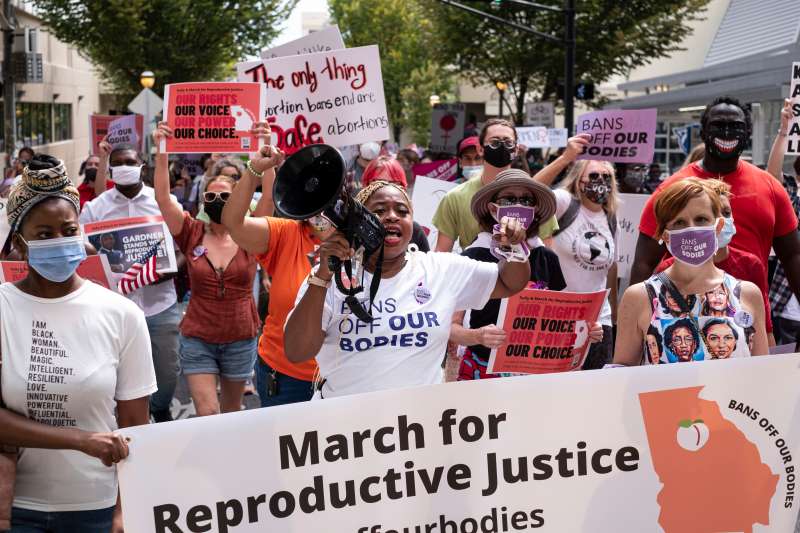
| Last February, Adriana Smith, a 30-year-old nurse in Atlanta with a 5-year old son, went to the hospital with a severe headache. Doctors did not perform a CT scan and sent her home, dismissing her concerns. When she returned to the emergency room, doctors discovered blood clots spreading throughout her brain. By then, it was too late. She was declared brain dead. But Smith was nine weeks pregnant. Under Georgia’s six-week abortion ban, that meant her family had no say in what happened next. She was kept on life support for months against their wishes, until the fetus reached viability. Her mother, April Newkirk, described the experience as “torture.” “My daughter did not die of a medical emergency alone,” said Newkirk at a press conference this week. “She died inside of a system that had already decided her body wasn’t hers, a system that made our family spectators to her fate, a system allowed to thrive post-Dobbs.” Smith’s case has become one of the most visible symbols of what life looks like in Georgia four years after the Supreme Court overturned Roe v. Wade and handed states the authority to impose sweeping restrictions on abortion. |
The impact of Dobbs
Since Georgia’s six-week abortion ban took effect after the Supreme Court’s 2022 Dobbs decision eliminated the constitutional right to an abortion, Georgia OB-GYNs and physicians have reported witnessing medical catastrophes.
Emergency rooms have turned away patients experiencing miscarriages, with doctors unwilling to intervene for fear of being accused of performing an illegal abortion. In some cases, women have been sent from hospital to hospital, bleeding, before finding a provider willing to treat them.
Physicians have watched patients deteriorate—developing life-threatening infections and losing dangerous amounts of blood—before feeling legally safe enough to act. Under Georgia’s law, a fetus is considered a person, which means terminating a nonviable or failing pregnancy can expose a physician to criminal prosecution, the loss of their medical license, or both.
And women have nearly bled to death because they were too frightened to seek care after performing abortions at home, aware that walking into an emergency room might mean walking into a legal nightmare.
“People who are pregnant are being denied treatment and dying during miscarriages because doctors are afraid to care for them,” said Pavitra Abraham, director of state campaigns at Reproductive Freedom For All.
A state running out of doctors in the middle of a crisis
The consequences extend beyond individual cases. More than half of Georgia’s counties have no OB-GYN physicians, according to the Georgia Public Policy Foundation. And that pipeline is shrinking: Applications to OB-GYN residency programs in states with abortion bans have dropped further compared with applications in states without bans.
“I have talked to multiple medical students and residents who say they aren’t going to stay in Georgia because they don’t want to be in an environment where they can’t practice evidence-based medicine and have to worry about whether they are going to be criminally prosecuted, have their license removed, and have their livelihood threatened,” said Dr. Nisha Verma, an OB-GYN in Atlanta.
The result is a state where accessing maternal care is increasingly scarce and dangerous. Last year, Georgia had the second-highest maternal mortality rate in the country.
Black women bear the sharpest burden. According to state data, they are more than twice as likely as white women to experience severe complications or die due to pregnancy. Nationally, that racial gap has only widened since Dobbs.
The future of reproductive rights in Georgia
For reproductive rights advocates in Georgia, the concern is not only the present but also what the next election cycle could bring.
Two candidates currently vying for statewide office have staked out positions that would push Georgia’s laws even further. Gubernatorial candidate Rick Jackson, who also identifies as staunchly anti-abortion and supports the state’s six-week abortion ban, was captured in leaked audio saying that women should have to “”prove” they were raped to qualify for an abortion under Georgia’s existing rape exception.
Rep. Mike Collins, who is running for U.S. Senate, does not support exceptions for abortion in the case of rape or incest. He has sponsored the federal Life at Conception Act, which would ban abortion nationwide and could threaten access to IVF. He has publicly celebrated the Dobbs decision as bringing America “one step closer to ending abortion.”
Dr. Michael Greenwald, a pediatric emergency physician in the Atlanta area, called the prospect of Collins in the Senate “terrifying for Georgia women and families.” Dr. Greenwald has treated young girls who became pregnant through rape and incest. Without those exceptions, he said, they would have been forced to carry those pregnancies to term, endangering their lives.
A federal ban on abortion like the one Collins has proposed could place more families in the horrifying situation of April Newkirk—struggling to make sense of a tragedy that should never have occurred.