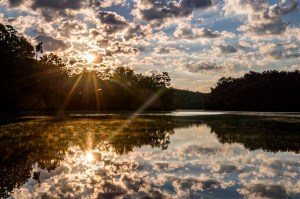
Stormy Bost moved to Calhoun, Georgia, when she was 5 years old. There was a river in her family’s backyard where she spent her summers splashing in the water and rolling in the mud, searching for relief from the unrelenting Southern heat. She had no reason to think the river could hurt her.
Twenty-five years later, the symptoms arrived without warning. She suddenly gained sixty pounds. Every time she took a shower, a painful rash spread across her skin in a pattern her doctor called a “Christmas tree rash.” She developed a goiter on her thyroid.
Everyone around her seemed to be sick, too. Her teenage daughter went on thyroid medication to manage her hormones. Her husband, in his 30s with no previous medical issues, suffered a seizure and spent multiple days in intensive care. Two of her coworkers’ husbands were diagnosed with thyroid and liver cancer, she said.
Bost’s doctor, who had been following research showing troubling levels of toxic chemicals in local water, encouraged her to get a blood test. The results were alarming. The concentration of per- and polyfluoroalkyl substances—known as PFAS, or “forever chemicals”—was far beyond what scientists consider a safe level of exposure.
“Everybody here knows someone who’s sick,” Bost said. “Starting to connect the dots was terrifying.”
At the center of the nightmare is Mohawk Industries, one of the world’s largest flooring companies, which is headquartered in Northwest Georgia. For decades, Mohawk discharged wastewater laced with PFAS into the region’s rivers and streams. The chemicals, which were used to make carpets stain-resistant, are so durable they can take centuries to break down. Scientists have linked them to thyroid disease, reduced fertility, and elevated risks of several cancers.
Now, as communities across the region fight for accountability, Courier Georgia has found that Derek Dooley, a Republican candidate for US Senate, holds tens of thousands of dollars in Mohawk Industries stock, according to his federal financial disclosure forms. The disclosure, which candidates are required to file, reveals that Dooley owns between $16,002 and $65,000 in Mohawk stock, while his wife owns between $1,001 and $15,000.
The revelation has raised pointed questions from residents who say the carpet industry has spent years using its economic and political influence in Georgia to avoid responsibility, and who worry about what it means to send a Mohawk stockholder to Washington.
“I’m a person who gets disgusted when money talks more than human rights and wellbeing,” said Bost.
Questions for Dooley
Dooley, a former University of Tennessee football coach and the son of legendary University of Georgia coach Vince Dooley, entered the Republican primary in August 2025 with the backing of Gov. Brian Kemp. He has never held elected office and has campaigned explicitly as a political outsider who will put Georgia first and push back against Washington’s entrenched interests.
Among the planks of his platform is a pledge to ban stock trading by members of Congress. He has described financial conflicts of interest as a defining symptom of a broken political system.
Yet his financial disclosure forms show he and his wife hold up to $80,000 in stock in a company that is simultaneously fighting lawsuits from constituents in his own state, spending heavily on lobbyists to limit those constituents’ legal rights, and publicly denying responsibility for a health crisis that has raised cancer rates throughout Northwest Georgia.
Courier Georgia reached out to the Dooley campaign with detailed questions about his Mohawk stock holdings, whether he plans to divest or place his investments in a blind trust if elected, and whether he believes he can advocate for PFAS-affected communities while holding a financial stake in one of the companies those communities are fighting in court.
The campaign did not respond.
‘The Warning I Got Was You Just Don’t Talk About It.’
Lisa Martin moved to Northwest Georgia from California in 2002 and started working at Mohawk Industries two years later. During her first months on the job, co-workers invited her to take a walk along the river during lunch. What she saw stopped her cold.
“The water changed colors with whatever was being processed in the mill that day,” she said.
When workers tried to raise concerns about what was flowing into those waterways, Martin said, they were fired. The carpet industry is the economic backbone of the region, employing tens of thousands of people in and around Dalton, the self-styled “Carpet Capital of the World.”
Northwest Georgia produces roughly 90% of the carpet manufactured in the United States, and the industry’s dominance has long translated into a culture of silence around its human and environmental impact.
“The warning I got was you just don’t talk about it,” Martin said. “The carpet industry was the bread and butter of the community. If you bucked them, you didn’t have a job. So you just tolerated it.”
But old-timers in the community, Martin said, understood which days were safe to swim and which were not. There was a widespread understanding that something in the water was wrong, even if no one could precisely name the cause.
What Mohawk Knew
Mohawk has consistently maintained that it did not know their products were dangerous, saying it relied on assurances from its chemical suppliers, 3M and DuPont. The carpet company says it followed all state and federal regulations.
But, as first reported in an extensive investigation by The Atlanta Journal-Constitution, AP, The Post and Courier, FRONTLINE (PBS), and AL.com, the picture is more complicated. Documents suggest that by 2008, at the latest, Mohawk had access to data showing PFAS were moving through local waterways at significant concentrations. They were also made aware of studies that showed PFAS caused higher rates of cancer in animals.
But Mohawk did not stop using the chemicals until 2019, more than a decade later. In court filings, 3M and DuPont have argued that it was the carpet industry, not the chemical suppliers, that ultimately put PFAS into the waters of Northwest Georgia.
“They knew,” said Dolly Baker, a Calhoun resident whose blood was found to contain PFAS at roughly 260% the national average. “Maybe not in the beginning, but at some point they knew it was toxic and they continued to let it run off into the water.”
Lobbying to avoid litigation
As lawsuits have mounted, carpet companies have moved aggressively to limit their legal exposure. During Georgia’s most recent legislative session, Republican lawmakers pushed for legislation that would proactively shield carpet manufacturers from contamination lawsuits.
Georgia House Bill 211, dubbed the “PFAS Receiver Shield Act,” would have classified carpet companies as “PFAS receivers.” The bill sought toframe carpet companies like Mohawk as victims of their chemical suppliers, rather than responsible parties who could be sued for damages. Under the bill, people would have been required to prove “gross negligence,” a legal standard that experts say would make successful lawsuits extremely difficult to win.
The bill drew immediate fury from residents, who largely blame carpet manufacturers for the crisis. They also note that Mohawk is worth more than $6 billion. The company had the resources to have understood the risks of discharging PFAS into shared waterways.
“You have the funds to do the research, so there was no need to cut corners,” Bost said.
That the companies did not pause to understand what the health and environmental outcomes could be in local communities is ridiculous, Bost added.
The bill did not become law. But residents say it illustrates the scale of the industry’s political reach. It also emphasizes why they are troubled by the prospect of a US senator with financial connections to Mohawk.
“Any future politician who has ties to the carpet industry is going to have to answer: How are they going to remain unbiased? How are they not going to end up being used by the industry to protect it from responsibility and accountability?” Martin asked.
She says if Dooley has stock in Mohawk, he will be compelled to protect those profits, rather than vulnerable Georgians.
“It is not in the best interest of their community and their constituents to have financial ties to the industry we’re asking them to protect us from,” she said.
A hundred years of consequences
There is no quick fix for what has happened to Northwest Georgia. PFAS bind to soil and infiltrate groundwater, and they do not degrade on a human timescale. Cleanup experts say full remediation of affected land and waterways could take generations and cost hundreds of millions of dollars.
The Conasauga River, which flows south through Georgia and into Alabama before eventually reaching Mobile Bay, carries the contamination far beyond the communities where it originated, affecting drinking water supplies for hundreds of thousands of people across two states.
“A hundred years from now, we’re still going to be battling what’s happened here in the last few decades,” Martin said. “It will still be on our land. It will still be in our air. We’ll still be figuring out what we’re going to do to restore our community and our environment.”
The demands residents are making are not, they say, unreasonable. Baker believes county governments and carpet companies should be required to provide every affected home with a filtration system.
Bost believes the companies should go further and cover residents’ ongoing medical costs. In Whitfield County, home to Dalton, roughly one in five residents has no health insurance. In Gordon County, home to Calhoun, the rate is nearly the same. Many of the people most heavily exposed to PFAS are the same people least equipped to pay for the testing, treatment, and ongoing monitoring that doctors say they need.
After finding out the amount of PFAS in her blood, Bost purchased a $350 water filter for her kitchen.
“That’s not a realistic thing for a lot of people living paycheck to paycheck. They can’t go do that,” she said. “There are a lot of people that are going to die around here before they ever figure out that PFAS is the reason why.”
For Bost, whose own children cannot swim in the rivers she was raised in, that means one thing: “I don’t want anyone in office who is benefiting from the poisoning of the people in their town.”