Danny Lee Proctor grew up in the Piney Woods of Texas, along the Texas-Arkansas border, where he still lives. Sweetgum and bald cypress trees grow alongside the Red River. Wright Patman Lake shimmers in the late-afternoon sun. Four school districts straddle the two states, but most people still know and recognize each other.
“We’re a close-knit community,” he said.
Yet in recent years, Proctor and his neighbors have watched the natural beauty and tight-knit feel they grew up with come under pressure they never anticipated: proposals for several hyperscale data centers, arriving in quick succession across a rural county of roughly 92,000 people.
“We’re batting on all fronts,” he said.
This week, Proctor picked one of those fights and made it personal. In an open letter addressed directly to Rick Jackson, the Republican candidate for governor of Georgia, Proctor asked Jackson to hold himself to the same standard for data centers that he has advocated for in public.
“We are against the idea that rural communities should have less influence over their own futures because the people developing around them possess more money, more attorneys, more political connections and more power,” Proctor wrote.
Jackson has built his campaign for governor, in part, on the idea that Georgia communities—not distant officials or corporations—should decide whether a data center gets built in their backyard. Proctor’s message asks whether that principle extends to a project in the corner of East Texas where Proctor lives and Jackson has a documented financial interest.
“If communities in Georgia deserve the right to decide whether a data center belongs in their backyard, why should the people of Hooks, Texas, deserve anything less?”
Proctor is not a lone letter-writer. He is part of a local group, No Bowie County Data Centers, that has spent months organizing residents at a local diner, showing up at commissioners’ meetings, and pressing officials for specifics on water use, power demand, and environmental review. They have urged elected officials to reject the data center proposals that are tied to Rick Jackson’s company, but have so far been unsuccessful.
“The decisions made by a few are destroying the lives of many,” Paula Sorenson, another resident, said at a recent community meeting opposing the surge of data center projects in her area.
A billionaire’s stake in Texas
Jackson has said publicly that he has money invested in a Texas data center project. Asked by the Macon TV station 13WMAZ in April about his views on data centers, he said he understood the issue firsthand.
“I do have an investment and that’s the reason I’m knowledgeable about it,” he told the station.
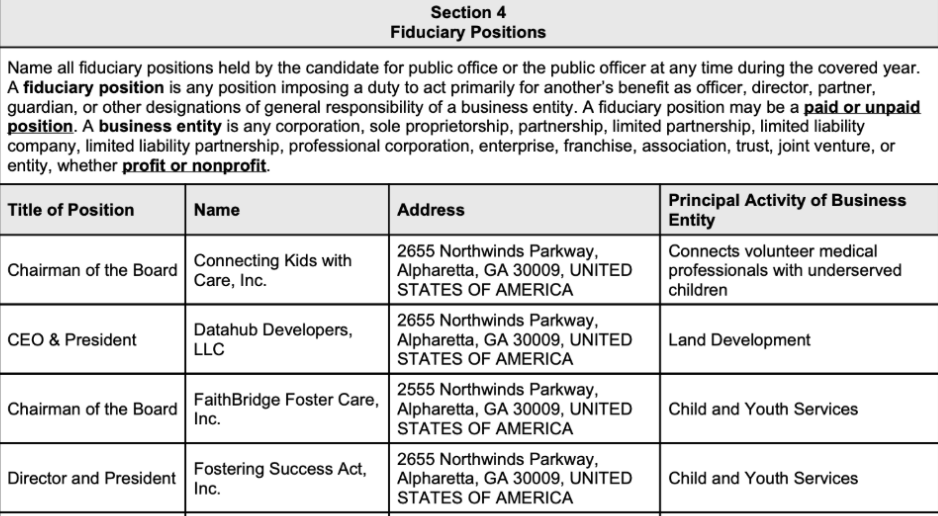
Jackson’s financial disclosure form, filed with the Georgia’s ethics commission, lists him as “CEO & President” of a company called Datahub Developers, LLC. The company’s address is the same one used by Jackson Healthcare, the staffing company that made Jackson his fortune.
Datahub Developers, LLC isn’t alone. According to OpenCorporates, at least three similarly named companies were set up since April 2024: Datahub Developers Holdings, Datahub Developers Parent, and Datahub Developers Texarkana I—the same area where Proctor lives. Each of these companies shares the same Alpharetta address as Jackson’s other businesses and Jay D. Mitchell, the general counsel at Jackson Healthcare, incorporated them.

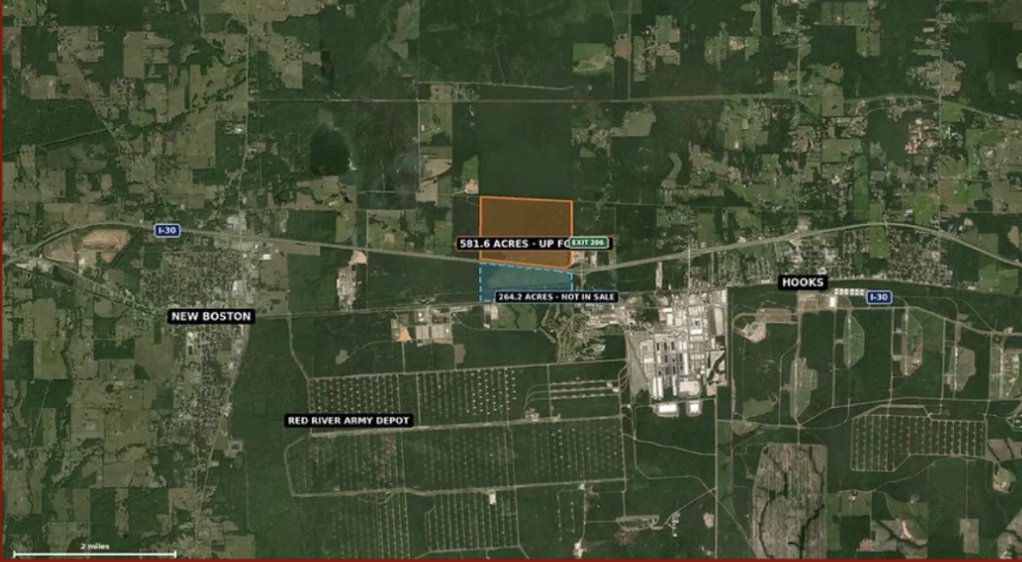
Datahub Developers, LLC is tied to two neighboring pieces of land in Bowie County, Texas, which together form an expansive stretch alongside Interstate 30.
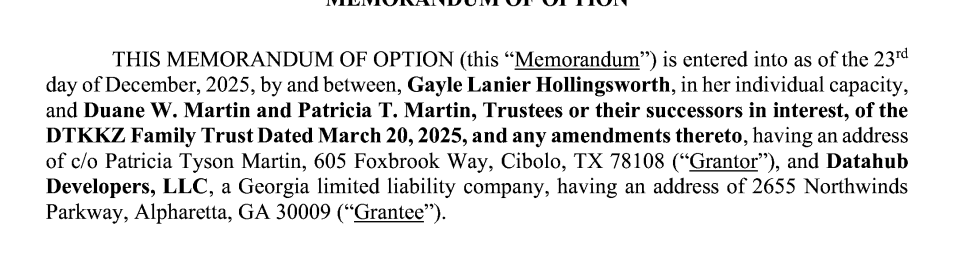
In December 2025, Datahub Developers signed a “memorandum of option” to purchase a 163-acre tract from a family trust. The person who signed for Datahub Developers LLC wasn’t Jackson—it was Bob Powell, listed in the document as the company’s president—who has had a long-term relationship with Jackson’s companies.

Powell’s LinkedIn page says he’s the founder and CEO of a separate company, Foundrie Hyperscale Data, which builds data centers. On Foundrie’s website, the company boasts about a “flagship development” in East Texas, Louisiana, and Arkansas.

It isn’t clear from the paperwork why Powell signed as Datahub’s president when Jackson’s disclosure lists him as holding that same title. But the two men do have a history together. In a 2022 interview, Powell mentioned “my business partner from the Jackson Investment Group,” a company that SEC records confirm is one of Jackson’s own investment firms. The men were doing business together years before Datahub ever existed.
The second piece of land tied to Datahub is bigger: a 582-acre tract that Bowie County, along with two local economic development nonprofits, had jointly owned since 2020.
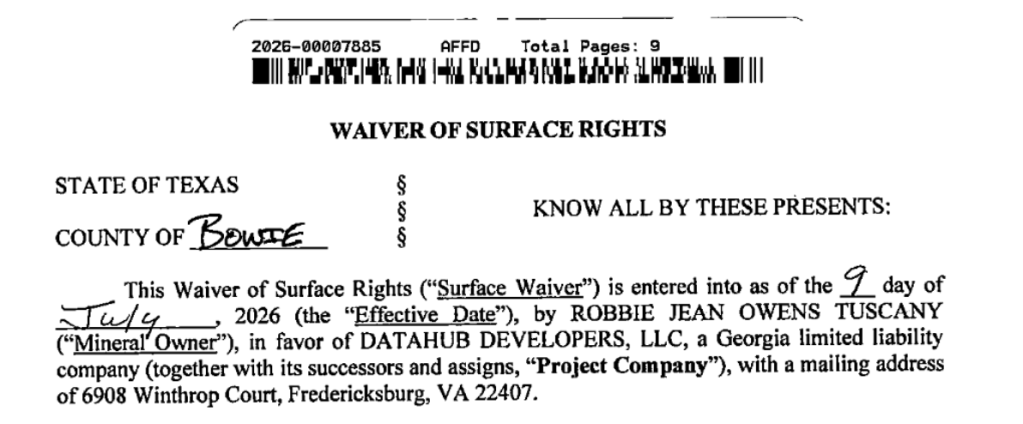
A separate document filed in Bowie County this August, a Waiver of Surface Rights, names Datahub Developers as the “Project Company” planning to build on that land. That’s the same tract the county and economic development nonprofits voted in August to fully sell for data center development.
A $12 million sale and a confidentiality clause
That August sale is the one Proctor and his neighbors packed the Bowie County Courthouse to fight. Dozens of residents showed up to a special commissioners’ meeting to press officials on property values, pollution, water use, and the county’s approach to economic development before the sale was approved.
County Judge Bobby Howell told the crowd that the three government entities had originally paid about $1.5 million for the land and were selling it for $12 million, a return he called “tremendous,” separate from any revenue the data center itself might eventually generate.
When Proctor, who attended the meeting, asked whether commissioners had signed a nondisclosure agreement covering the sale, Judge Howell confirmed they had, describing a confidentiality clause as standard practice in real estate contracts.
“We signed a contract that had a confidentiality clause,” Howell said.
That pattern is exactly what strikes Proctor as irreconcilable with what Jackson has said publicly about data centers.
In an op-ed for the Atlanta Journal-Constitution, Jackson wrote that decisions about data centers “should never be decided behind closed doors,” and that the people who live with the consequences “must have a meaningful voice in the decision.”
“You said the people who must live with the consequences deserve a meaningful voice,” Proctor wrote to Jackson, quoting the same language back. “Now you have an opportunity to demonstrate whether they are also a standard you are willing to live by.”
Proctor’s letter does not ask Jackson to abandon the project outright. It asks him to meet the people who live near it—”without consultants, press, or talking points,” as he put it—before any sale becomes final, and to answer specific questions about water sourcing, disposal, and long-term monitoring that he says local officials have so far answered only in generalities.
Whether Jackson will take up that invitation is, for now, an open question. As of this writing, neither Jackson’s campaign nor Bob Powell had responded to requests for comment on the letter or the underlying land transactions.
For Proctor, the answer matters less as a matter of corporate structure than as a test of character—whether a man who has spoken at length about growing up without money, connections, or power is willing to extend that same deference to people who currently have none of those things.
“There is always another tract of land,” he wrote. “There will always be another development site.”
Families who have spent generations building their lives along the Red River, he said, do not have that luxury.