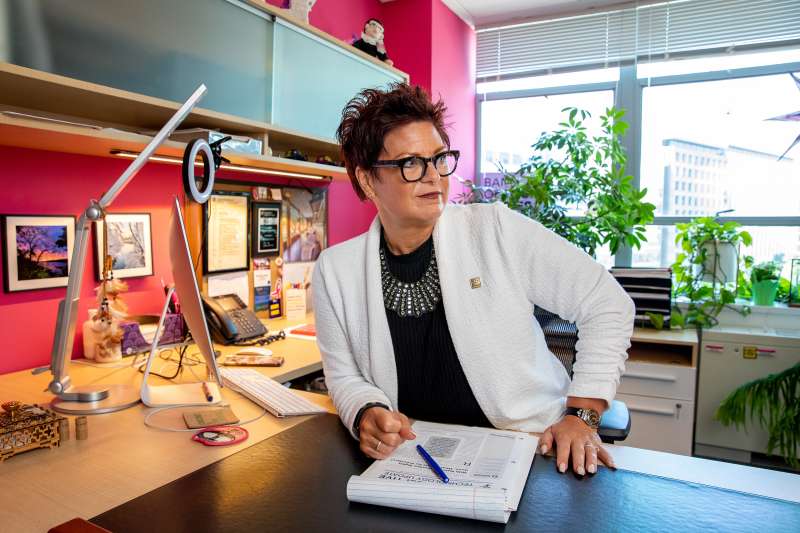
Melissa Grant is the co-founder and chief operating officer of Carafem, a nonprofit reproductive healthcare organization operating across the US, including Georgia. Here, she shares her story with Courier Georgia special correspondent Bonnie Fuller and explains why she is so determined to keep providing trustworthy, judgment-free abortion care—especially with abortion access on the ballot again in the midterm elections.
“Abortion: Yeah, we do that.”
That’s our tagline for the Carafem clinics. We wanted to be absolutely crystal clear to patients that we were an abortion provider ever since we opened the first of our Carafem women’s health clinics. We wanted to destigmatize the need for abortion.
So often, it can be hard for women to find a clinic that provides abortion care. Crisis pregnancy centers, which are usually illegitimate healthcare providers whose staff try to convince women not to get abortions, do a really good job of confusing people about their purpose.
So when someone calls one of our clinics, we don’t let women have to hem and haw and beat around the bush. The people who answer our phone jump right in and say, “How can we best help you? Are you looking for an abortion?”
Callers can be so relieved. Not everyone comes from a supportive environment. When you pick up the phone at an abortion clinic, you may be the first person that a patient has ever told that they are pregnant.
A mother’s lessons in compassion
When I grew up in eastern Iowa, it wasn’t common to talk about sex and even less common to talk about abortion. My mom was the first person in her family to go to college. She became an advanced practice nurse specializing in genetics.
She worked with an OB-GYN, and she often cared for patients who were facing a devastating diagnosis during their pregnancies. She didn’t want to call patients with the news in the middle of their workdays, so she would call in the evenings when they could ask questions without having to worry about who might be around.
She taught me that people needed to get clear, accurate information and that it needed to be delivered with respect and compassion and without judgment.
As kids, we learned that this was a highly respected time and we had to be quiet—Mom needed to help somebody.
My mom helped me understand that decisions about whether or not to continue a pregnancy could be extraordinarily complex and deeply personal. There was no single right answer and no single story.
These decisions were as wide and different as people in the universe, and they weren’t something that anyone could understand from the outside.
My mother also had nursing textbooks in the house. Since my friends had so many questions, I became one of those folks who often schooled my friends about how sex and bodies and birth control really worked.
I went to the University of Iowa and worked part time as a clerk in the OB-GYN department of a local hospital and loved it.
When a Planned Parenthood clinic opened up in our town, I applied for a job there. At the end of the interview, they told me that they were going to provide abortions there and asked if I would be OK with that. I said, “Well, of course!”
I worked my way from the front desk into as many different positions there as I could. I learned to provide educational information to patients, to assist physicians, to manage the clinic, and then to manage all the Planned Parenthood clinics in a state.
Then I was brought on by the national Planned Parenthood office when medication abortion became approved in late 2000, and I traveled to clinics across the country teaching medical providers how to use the abortion pill, mifepristone.
As an abortion provider, I have never questioned that there are people in the US who are deeply and passionately against abortion as an option. And then there are others of us who just as firmly believe that it’s a right and that people should be able to access it.
People have deep needs to have the option of abortion in order to change their lives in a way that they feel is better. They are the best ones to make that decision, not a politician.
The fact that people want to impinge on the rights of others makes me all the more determined to provide information in a way that’s welcoming and understandable, in clinics that are beautiful and comfortable, and in settings that are private.
My mom really helped me understand that it’s critically important to deliver care in this field that understands the needs of the individual, because individual needs are very different.
Building clinics where patients need them
Eleven years ago, I opened the first Carafem reproductive healthcare clinic in Chevy Chase, Maryland—very close to the Virginia and Washington, DC borders—in partnership with an organization that provided family planning services and abortion care internationally called DKT International.
We wanted to be in a location that was very close to Virginia and accessible to West Virginia patients. Today, the largest number of our patients at this clinic are from Virginia.
We opened an Atlanta clinic in 2016, our Chicago-area clinic in Skokie, Illinois, in 2018, and a clinic in Mount Juliet, Tennessee, in 2019.
By 2015, when we opened the first Carafem clinic, I could already feel the anti-abortion pressure in my home state of Iowa. Recognizing that abortion in Iowa could go away, I felt that the Chicago-area clinic could serve patients from Iowa, Wisconsin, Indiana, and Missouri.
We decided to open a clinic in Mount Juliet, outside of Nashville, Tennessee, when we saw that 30% of our patients were coming from that area. The first day we opened there, we filled up an entire month’s worth of appointments.
So every time that a politician says that people in Tennessee don’t want abortion care, it rings completely hollow with me. Politicians may not want it, but a heck of a lot of women and people who are pregnant do!
It’s the stories of patients who come to us that have always kept me determined to keep going. It’s the life circumstances they face when they say, “I don’t know what to do. Thank you for giving me this option.”
We have had people who have threatened self-harm versus not being able to get an abortion. It can be a hopeless place for someone who’s pregnant against their will or pregnant when they just don’t feel they can be.
We understand that whatever the circumstances are that lead a pregnant person to decide that they can’t continue their pregnancy are uniquely their own, and each can be extraordinarily devastating.
You only need to hear these stories for so long before you realize that (access to abortion) is a cause worth fighting for.
To me, there was no question: This is something that deserves respect, understanding, and assistance.
And if I don’t provide that access to abortion, who will?
Each of us who does this work has that gut-check moment.
When abortion bans forced a clinic to close
When Roe v. Wade was overturned by the Supreme Court, I had a kind of pain and sickness in the pit of my stomach. We had been lamenting for a long time before that about the legal restrictions that were happening in Iowa, my home state, and many other states across the country.
I had the fear that if good people didn’t rise up and do something about this, the Dobbs decision would happen. So we weren’t incredibly surprised when the Supreme Court overturned Roe. But still I had a feeling of disbelief.
How could this happen in a place as progressive as I felt the country was, that we could go this far backward?
It was heartbreaking when we had to close our Tennessee clinic after the state banned abortion from conception. It’s one of the strictest bans in the country. (Tennessee makes providing an illegal abortion a Class C felony with a prison sentence of three to 15 years.)
We had great lawyers and fought the law, but when there was no hope and when we closed, it was lonely and difficult. We felt like we were letting people down.
Now we’re back to a significant number of patients driving to our Georgia clinic, where they can still get abortions up to six weeks of pregnancy.
About 85% of our clients now actually choose our medication abortion option via telehealth, and then we ship pills through the mail to patients in 20 states, plus DC, up to 12 weeks of pregnancy.
I am fearful that the next target in this fight will be contraceptives—that they will become less available to people who need them.
We see the attacks (by Republicans) against institutions that have provided contraceptives at low or no cost for years, like Planned Parenthood. Our clinics provide a large variety of contraceptive methods at reduced cost.
Editor’s note: Donald Trump’s One Big Beautiful Bill Act cut all Medicaid funding for Planned Parenthood’s clinics for a year as well as for other reproductive health care clinics. The bill also cut long-term Medicaid funding to rural hospitals, resulting so far in the closure of 65 labor and delivery departments, women’s health centers and birth centers.
To me, defunding clinics that provide contraceptives seems to be part of the attack that takes away women’s ability to make decisions about their own reproductive healthcare. It detracts from enjoying sex just for sex’s sake and not just to have children. That should be a fundamental right. I think a deeply satisfying sex life is an important piece of being human.
I am hoping that our rights prevail. It’s going to take a really long time, but if I allow myself to sit in a place of gloom and despair, it makes it hard to come to work. This isn’t a glamorous life. There are much easier jobs to do. But when a person who is in such a deeply personal and vulnerable place comes to us for help, it just feels like the right thing to do.
It’s very moving, and I feel very grateful that I’ve had the opportunity to do work in my life that is so meaningful to me. And my mother is proud of me.
READ MORE: At a Georgia abortion clinic, 27 of 30 women were turned away in one afternoon