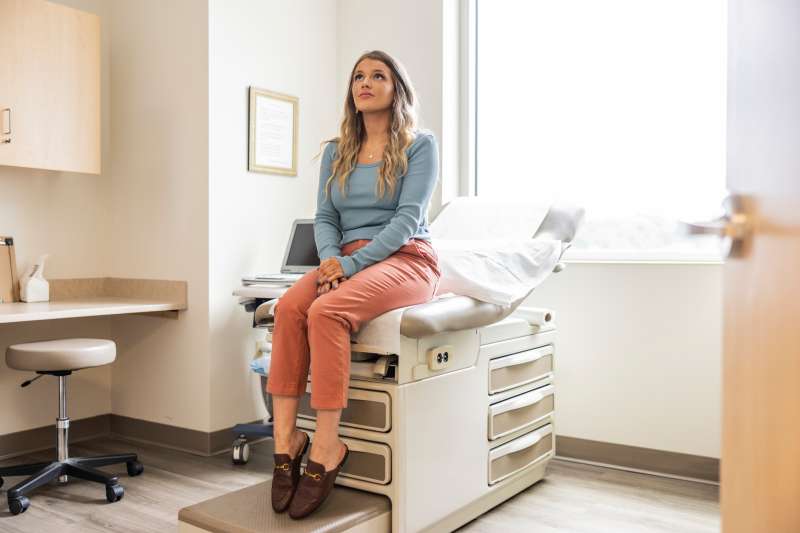
Rebecca found out she was pregnant on a Saturday. By Tuesday, she was sitting in a Georgia reproductive health clinic waiting room with roughly 30 other women, all racing the same clock. None of them were getting abortion care that day—at least not in Georgia. Like a growing number of Americans, they’d have to leave the state to get one.
Georgia law bans abortion once a fetal heartbeat is detected, usually around six weeks of pregnancy. But that count doesn’t start at conception. It starts from the first day of a woman’s last period. That meant the clock had already been running for weeks before Rebecca even knew she was pregnant.
“When I was trying to book appointments, each website said I was already five weeks pregnant, and by the time I got into an appointment, it might be too late,” she said. “Heartbeats can be detected between weeks five and six, and Georgia bans any abortions after heartbeats are detected.”
Rebecca wasn’t on hormonal birth control, and the morning-after pill doesn’t work for women above a certain weight. “A little-known fact,” she said. So when her period was late, she got a pregnancy test. Her cycle normally runs longer than average, about 33 days.
Within five minutes of the positive result, she was searching for clinics where she could have an abortion, but every site told her the same thing: She was already five weeks along. By the time she could get an appointment, it might be too late.
She managed to secure an appointment for Tuesday, over a long holiday weekend.
About 30 women sat in the waiting room with her: younger women, older women, every ethnicity. One by one, they went in for ultrasounds to see whether a heartbeat could be detected. And then, one by one, almost all of them came out with the same story.
They’d have to drive to Charlotte, North Carolina, because they were a few days past the limit for abortion care in Georgia. Some had already driven in from Louisiana or Florida, a six-or seven-hour journey. Now, they were being told they needed to drive four more.
Rebecca’s ultrasound showed no heartbeat, only what she described as a “dark spot.” Rebecca said she was one of three women out of the 30 she observed who were sent to a second waiting room that day. There, she was given mifepristone—an oral medication used to end an early pregnancy—and told to come back in a week or two to confirm it had worked.
Rebecca described the experience as “hardly worse than a regular period and a few days longer.” The following week, she confirmed she was no longer pregnant.
But while her story had a less complex resolution, the image of the other 27 women in the clinic waiting room has stayed with her.
“How many of them risked losing their jobs or having to drop classes because they were forced to drive hours away twice in two weeks? How many couldn’t afford that?” she said. She thinks about what she would have done at 23 years old instead of 37.
She definitely couldn’t afford the $500 for the initial appointment back then. There would have been time to raise that money before the deadline passed, let alone arrange travel and pay for a hotel room.
For over a decade, before the Affordable Care Act passed in 2010, Rebecca didn’t have health insurance. She relied on Planned Parenthood as her sole medical provider. Not for abortion care, she’s careful to note, but for general gynecological care.
“I knew, no matter what state I was in, if there was a Planned Parenthood, I could get affordable care as long as I could get there,” she said. She described drives of two to four hours each way.
In 2019, Georgia’s abortion laws changed significantly with the passage of House Bill 481, which was designed to ban abortions after roughly six weeks of pregnancy, once cardiac activity is detected.
Now, the Trump administration is reviewing the safety of mifepristone, which puts the accessibility of this medication at risk. According to the Guttmacher Institute, 83% of abortions in Georgia are medication abortions, one of the higher rates nationally. In Georgia, out-of-state doctors can legally mail mifepristone to patients using “shield laws.”
Mifepristone has been approved by the US Food and Drug Administration (FDA) for 25 years and has been used by more than 7.5 million people for abortion and miscarriage care, according to Planned Parenthood. Its safety and effectiveness have been evaluated in more than 100 peer-reviewed studies.
Research has also examined the health and economic consequences of being denied a wanted abortion, finding that restrictions on abortion access can lead to worse outcomes for people who are unable to obtain the care they sought.
While anti-abortion groups and Republican attorneys general can’t stop access to mifepristone via telehealth on a state level, they’re taking the fight to federal court instead, hoping to cut off access nationwide.
“These laws affect us all, whether we are aware of it or not,” Rebecca said.
“The anti-abortion majority in Congress and their allies want to ban all abortion, everywhere. They are a threat to our reproductive freedom, and they are on the ballot in November. The overwhelming majority of Americans want abortion to be legal,” said Angela Vasquez-Giroux, vice president of communications, Planned Parenthood Votes.
“Voters understand that at no point in pregnancy is a politician more qualified to make decisions about your health than you and your health care provider—and they’re not going to put more politicians in office who will stand between them and the care they need.”
Rebeca said she has never once regretted her decision.
“It’s not for lawmakers to decide what happens with our bodies,” she said. “This could easily be your teenage daughter who’s about to start college and made a mistake, or your wife who desperately wants a child, but the pregnancy isn’t viable. Regardless, their options in medical care shouldn’t be made by politicians’ religious beliefs.”