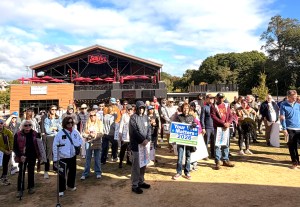
Dozens of protesters gathered outside of the Signia by Hilton Hotel on Wednesday night, where the Atlanta-based company Flock Safety was hosting its annual “Flock Forward” public safety conference.
But the demonstrators had a different message. Flock cameras were making their communities less—not more—safe.
They were part of a coalition called Flock Off, which is dedicated to ending the use of Flock cameras in Georgia. Their rally was one piece of a much larger effort: The National Week of Action Against ALPRs, a nationwide series of protests targeting automatic license plate recognition (ALPR) systems. ALPR’s are the artificial intelligence (AI)-powered cameras that let companies like Flock track people across wide swaths of the country.
The week of action emerged due to the public’s growing concerns over the ubiquity of Flock cameras, especially in Georgia. During the protest on Wednesday, multiple speakers mentioned that Atlanta was the most surveilled city in the country.
“Atlanta is frequently a testing ground for these types of surveillance techniques and ideas,” said Kamau Franklin, founder of Community Movement Builders,a Black member-based collective of residents and activists . “Just like we don’t want a Cop City, we don’t want a Flock City.”
Franklin isn’t alone in this opinion.
The Atlanta metropolitan area has become the hub of widespread pushback against the company. In Dunwoody, Jason Hunyar spent months filing open records requests and speaking at Dunwoody City Council meetings after discovering that Flock employees had accessed live camera feeds from the pool and gymnastics rooms at a local Jewish community center. Groups from Marietta and Emory University have also recently protested Flock’s surveillance of their communities.
In addition to privacy concerns, many protestors expressed concern at the misuse of Flock cameras by police officers. A Braselton police chief was arrested last November after investigators found he had searched the database for his ex-girlfriend’s license plate roughly 600 times. In July, a Conyers dispatch supervisor was arrested for tracking a partner’s vehicle. And this summer, three former Bibb County sheriff’s deputies were arrested on stalking-related charges tied to Flock misuse.
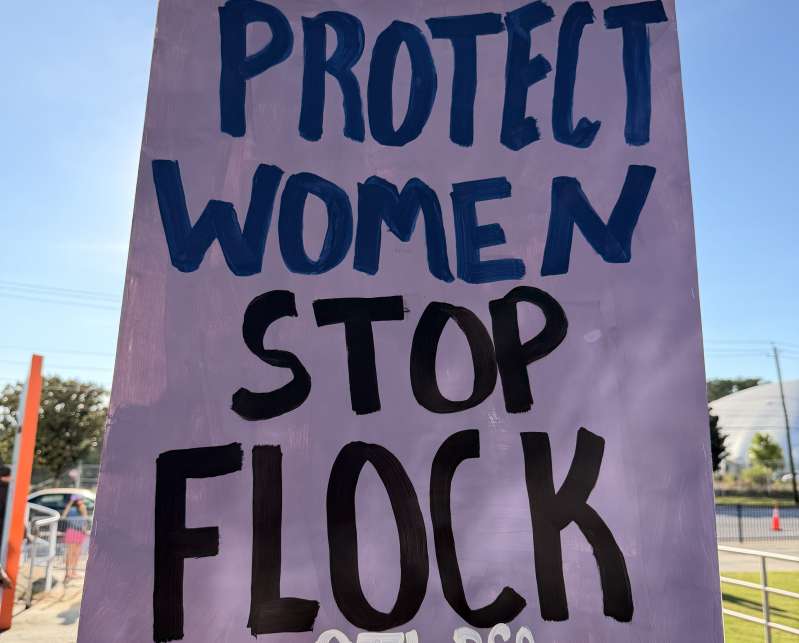
One protestor held a sign that said “Protect Women, Stop Flock,” referring to some of these instances and others.
Other protesters expressed their concerns about Flock’s ties to US Immigration and Customs Enforcement (ICE).
While Flock does not have a direct contract with ICE, reporting from 404 Media last year has found that local police departments have used Flock to run searches on ICE’s behalf, including more than 4,000 logged searches nationwide tied to immigration enforcement reasons.
The conference was shrouded in controversy before it began. The company refused to allow reporters to attend, including WABE and Atlanta News First, even after Atlanta News First offered to pay the conference’s registration fee.
“Flock is a private company. They’re entitled to close their events to the public. But the attendees are largely public officials spending public dollars. There is a note of irony that the company that records you doesn’t want to be recorded,” wrote Brendan Keefe, chief investigator for Atlanta News First.
“We offered to buy a ticket. Flock said no. Flock offered police department employees resources to justify the expense. So your tax money is paying for public officials to attend a closed door meeting with a private vendor who can record your movements, but we can’t record them,” he continued.
In addition to the public officials inside, police officers from the Atlanta Police Department surrounded the hotel. That drew the ire of protesters, who noted that taxpayer funds were going to protect an event to sell a product that much of the public denounces.
Across the country, municipalities have ended their contracts with Flock. Advocacy group DeFlock counts roughly 95 municipalities nationwide that have rejected or canceled Flock contracts as of late July. On Wednesday, activists said they hoped that Atlanta would be the next to join the ranks of cities that have canceled their contracts.
“Flock has made [Atlanta] their home, and we’re here to start kicking them out of this home,” said Franklin.