Late last year, Jason Hunyar, an expectant father in Dunwoody, Georgia, was watching a YouTube video about Flock Safety when he noticed something unsettling. One of the cameras in the video was filming the Greenway trail, a lush path he regularly walked on with his pregnant wife. He immediately wanted to understand how the footage was stored, who could access it, and under what circumstances.
“I’ve never been politically active before in anything,” he told Courier Georgia.
But Hunyar is about to have his first child, and the idea that his son could be surveilled from the moment he’s born is terrifying.
Flock Safety is an Atlanta-based company founded by Georgia Institute of Technology graduate Garrett Langley. Valued at $8.4 billion as of last year, it has become one of Georgia’s most celebrated business success stories. When the company opened a massive new manufacturing facility in Smyrna last year, Gov. Brian Kemp showed up to mark the occasion.
“We look forward to many years of partnership with Flock Safety in their efforts to help keep Georgians safe,” he said.
But not everyone is celebrating.
Civil liberties groups have described Flock’s products as “a dangerous nationwide mass-surveillance infrastructure.” Its Safe Cities subscription packages cameras, drones, and access to a national license plate reader (LPR) network into a single product sold to local governments. Despite the mundane name, LPRs do far more than track license plates. They are AI-powered tools that monitor people’s movements across state lines, connect law enforcement agencies, and create detailed digital records of where people go.
Since 2024, Flock has poured more than $1M into lobbying to embed its surveillance networks in cities and towns across the country, from Troy, New York to Flagstaff, Ariz. The company routinely approaches mayors and city council members behind closed doors, often pushing contracts over the objections of residents. But perhaps nowhere is Flock’s grip on elected officials tighter than in its home state of Georgia.
Georgia’s top cop and Flock
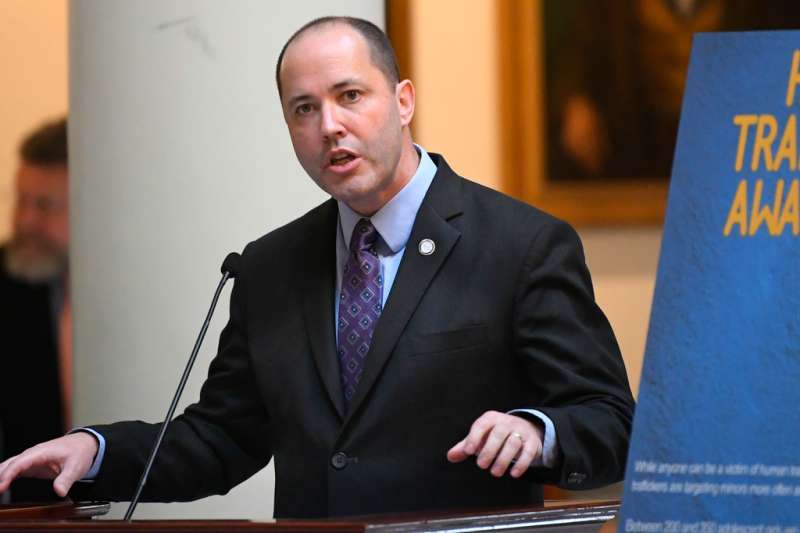
At the center of the relationship is Georgia Attorney General Chris Carr, the state’s top law enforcement official. Emails and texts obtained by Courier Georgia reveal a sustained, behind-the-scenes relationship between Carr’s office and Flock Safety in which Flock repeatedly lobbied Carr for favors and help securing preferential business outcomes.
Dunwoody, an affluent suburb of Atlanta, offers one window into that relationship. In February, residents in the city began pushing back on a Flock contract during city council meetings. The opposition was organized, vocal, and, apparently, a problem Flock needed help managing.
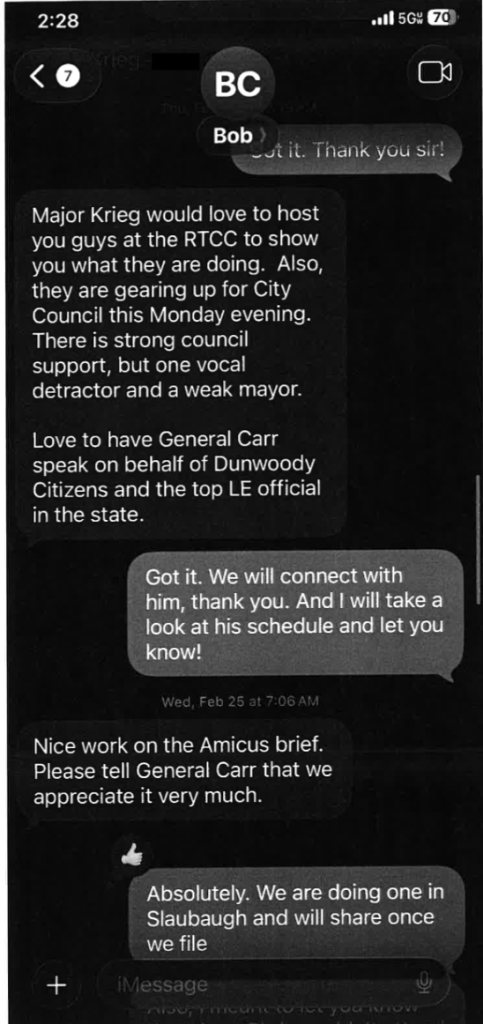
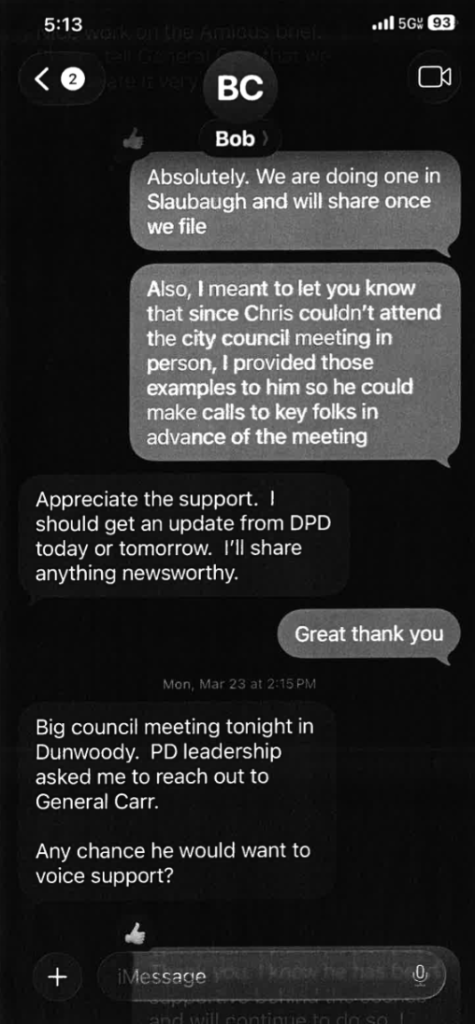
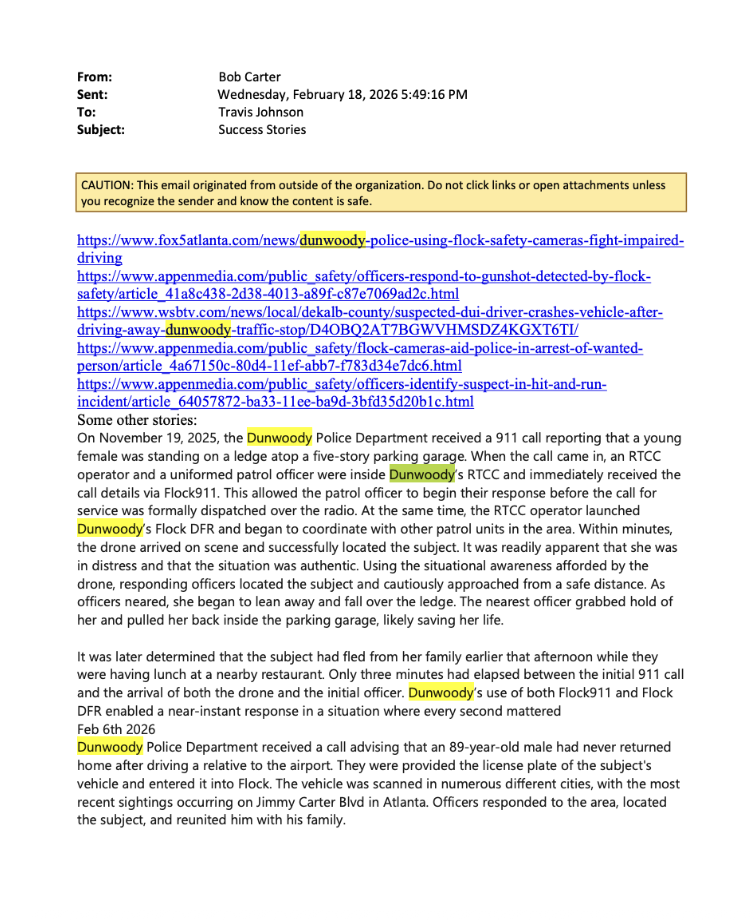
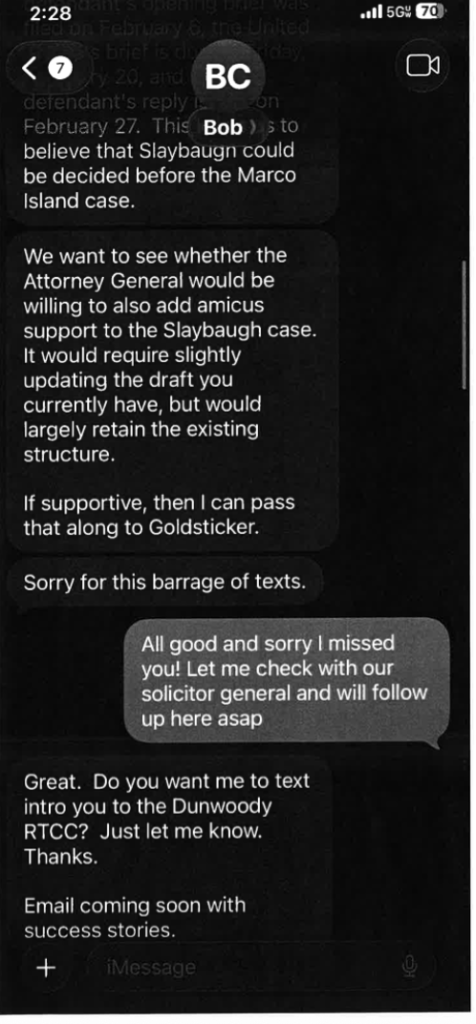
Bob Carter, Flock’s vice president of business development, didn’t respond by engaging with concerned residents. Instead, the documents show he texted Travis Johnson, Carr’s chief of staff, to ask whether the attorney general could personally attend the next Dunwoody City Council meeting. He also emailed Johnson multiple examples of Flock’s purported successes in Dunwoody to use as evidence when speaking to elected officials.
Carr couldn’t attend in person, but Johnson assured Carter that the Attorney General had made his support for Flock clear.
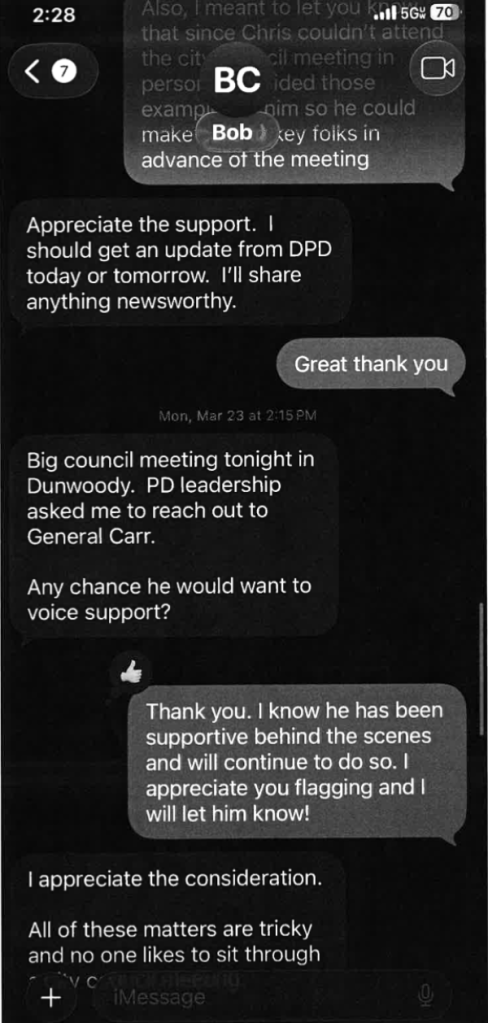
“I meant to let you know that since Chris couldn’t attend the city council meeting in person, I provided those examples to him so he could make calls to key folks in advance of the meeting,” Johnson wrote.
In March, Carter texted Johnson again before another council meeting, asking if Carr would “want to voice support.”
“I know he has been supportive behind the scenes and will continue to do so,” Johnson replied.
In April, the Dunwoody City Council approved an expanded contract with Flock despite many residents’ fury.
However, in an email to Courier Georgia, a spokeswoman said Carr never made calls to Dunwoody officials on Flock’s behalf. They pointed to multiple examples in which Flock’s LPRs were used to solve multiple cases of murder and kidnapping that were included in a brief as part of a 19-state coalition led by Carr to argue for the use of the technology.
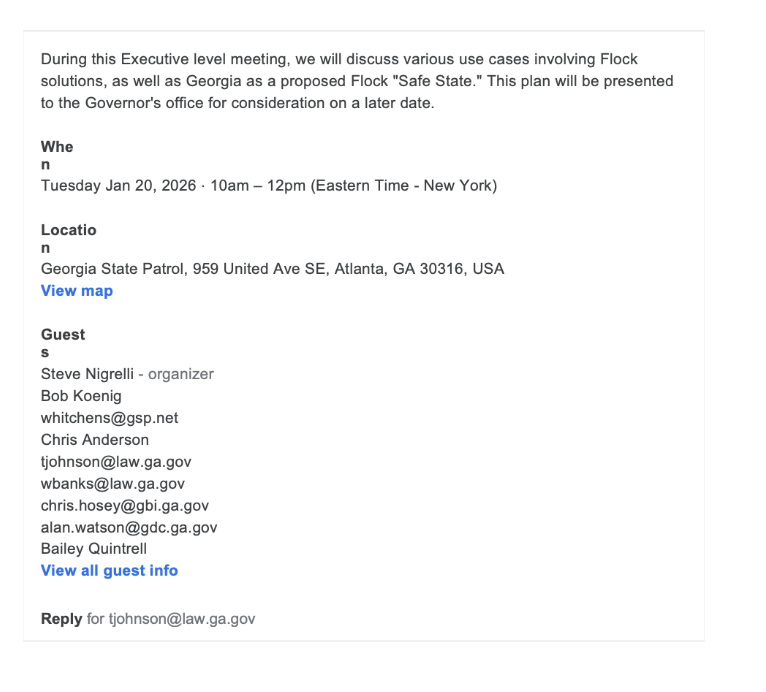
And Dunwoody may just be the beginning. Emails also show Flock met with top law enforcement officials from the Georgia Bureau of Investigations and the Georgia Department of Corrections to pitch a far more ambitious vision: turning Georgia into a proposed “Flock Safe State.” Again, a spokeswoman for Carr said they were not involved in this meeting.
The full scope of that proposal remains unclear, and Flock does not disclose the number of cameras it currently has in Georgia. However, independent researchers at the Atlas of Surveillance have mapped thousands of Flock cameras blanketing the state. Atlanta alone, by some measures, is the most surveilled city in the world. Georgia isn’t approaching the threshold of a surveillance state; it may have already crossed it.
Supporting Flock in court
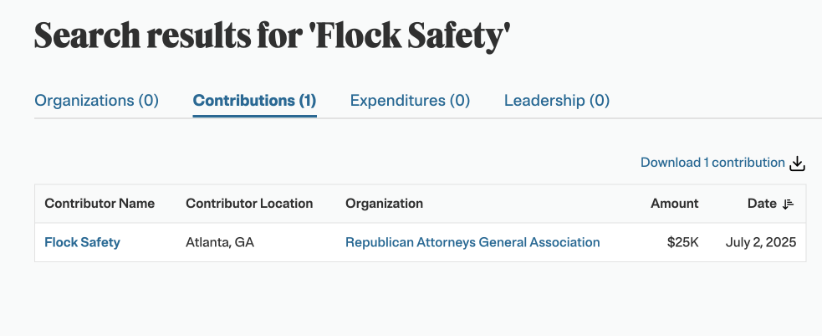
In 2025, according to a ProPublica report, Flock Safety donated $25,000 to the Republican Attorneys General Association, the national body that coordinates legal strategy among GOP state attorneys general. Carr is a member, although a spokeswoman for his office said he was not aware of the donation.
During the same conversation that Carter requested the attorney general’s presence at the Dunwoody city council meeting, he also asked whether Carr would write an amicus curiae brief on Flock’s behalf in a federal case. The case—United States of America v. Slaybaugh— is now before the 11th Circuit Court of Appeals, which covers Florida, Georgia, and Alabama, and could threaten the legal foundation upon which Flock operates.
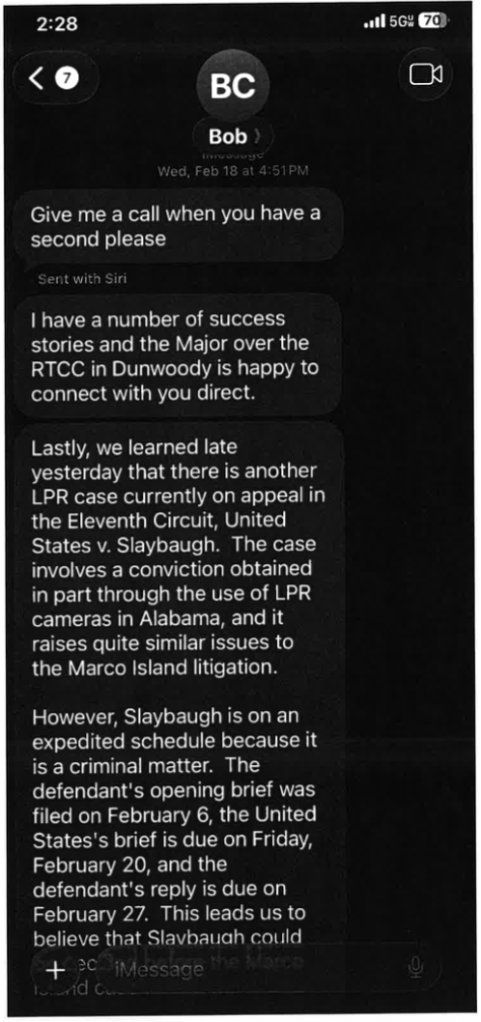
This is the question at the center of Slaybaugh: Does Flock violate the Fourth Amendment protection against unreasonable searches and seizures?
Law enforcement officials used Flock’s LPRs to track a man across state lines from Georgia to Alabama. If the court rules that such tracking is unconstitutional, the legal basis for Flock’s entire business could collapse overnight.
But Carr didn’t just file the requested brief on Flock’s behalf. He announced that he was leading a multistate coalition to support the government’s use of LPRs. He gained support from fellow Republican attorneys general, almost all of whom were part of the Republican Attorneys General Association that Flock previously donated to.
In the brief, Carr writes, “Georgia’s experience with ALPR technology, like that of its fellow amici States, confirms that stripping our state and local law enforcement of this vital tool would endanger our citizens while emboldening criminals.”
Privacy advocates see it differently. In an amicus curiae brief for the same case, The Project for Privacy and Surveillance Accountability argued that Flock’s systems collect vast amounts of data and use AI to build detailed profiles of individuals’ movements. They say that is precisely the kind of dragnet surveillance the Fourth Amendment was designed to prevent.
Carr wasn’t finished. In April, he published an op-ed in the Atlanta Journal-Constitution (AJC) defending Flock’s technology.
“Public safety is not an abstract concept. It is measured in lives protected, victims rescued and communities made safer,” he wrote.
But critics say the system endangers the people it claims to protect.
The use of AI surveillance
If the 11th Circuit rules against the government and, by extension, Flock, the consequences could extend far beyond one criminal case.
The ruling could set a precedent for whether Flock’s footage can be used in criminal and civil proceedings of all kinds, including cases involving people seeking abortion care or facing immigration enforcement. Those examples are not hypothetical.
Flock Safety was recently the subject of a congressional investigation following accusations that its technology was used to track a woman seeking an abortion across state lines.
According to Congressman Raja Krishnamoorthi (D-Ill.), a Texas sheriff’s office used Flock’s “National Lookup Tool” to search for her. Flock has denied the claim, calling it “unequivocally false,” and says the woman fled home after self-administering an abortion and that her family had asked the sheriff for help finding her.
The ACLU has also raised serious concerns about how the technology affects immigrant communities in Georgia. In his own AJC op-ed, ACLU of Georgia Deputy Executive Director Christopher Bruce put it starkly:
“In Atlanta, the most surveilled city in the U.S. — where cameras line highways, neighborhood streets, apartment entrances and parking lots — there is no way to get to work, school, church or a doctor’s appointment without being recorded. Accordingly, entire communities are forced to retreat into the shadows.”
Bruce also noted that the Atlanta Police Department shares its footage with over 2,000 departments across the country, including those that share data with Immigration and Customs Enforcement.
Fighting back
Across Georgia, residents are organizing to cancel Flock contracts and end the normalization of surveillance infrastructure.
In April, protesters descended on Flock’s Atlanta headquarters, representing a coalition of immigrant rights, civil liberties, and racial justice groups.
Hunyar is encouraging anyone who is concerned about Flock in their community to join the DeFlock Movement, a grassroots group working to map LPRs and dismantle Flock contracts one city at a time. Atlanta and North Georgia have an active chapter, and the national organization is hosting a week of action from Aug. 16 to 22.
The movement’s message is simple: “Surveillance isn’t inevitable. Over the last year, thousands of people across the country have risen up and said no to these private, profit-driven companies blanketing our cities, towns, and communities.”
For Hunyar, the stakes are personal. He worries that the surveillance his son is born into could follow him for life, shaping his opportunities if a youthful mistake is captured on a Flock camera and entered into a permanent record.
“Everyone makes mistakes when they’re kids,” he said. “That shouldn’t be tied to your permanent record.”