When Georgia Gov. Brian Kemp (R) ran for re-election in 2022, he made cutting taxes and saving Georgians’ money the centerpiece of his campaign. In the middle of the race, he signed a major tax bill that cut the state’s income tax rate from 5.75% to 4.99%. “This is designed to put more money into hardworking Georgians’ pockets,” Kemp told reporters and state lawmakers during the bill-signing session.
But three years later, another number has been eating into those same pockets: the electric bill. Georgia Power’s average residential bill has climbed by more than $43 per month since 2022, the result of six rate increases in three years.
Although Kemp doesn’t set electricity rates directly—that job belongs to the elected Georgia Public Service Commission (PSC)—he has appointed members of the PSC and vetoed legislation that could have driven down the cost of utility bills. He has repeatedly sided with Georgia Power’s growth agenda over measures that could have eased the load on ratepayers, ultimately taking money out of Georgians’ pockets at a moment when prices are incredibly high.
A cozy relationship with Georgia Power’s parent company
Georgia Power, the monopoly that provides electricity to Georgians, is owned by Southern Company.
Southern Company is one of the country’s largest utility holding companies, and its executives have done well even as customer bills climbed.
Tom Fanning and Chris Womack, the utility’s top two executives, made more than $55 million combined in 2023—the No. 1 and No. 4 highest-paid utility executives in the country, according to an analysis of SEC filings by Georgia Conservation Voters.
Southern Company’s own profits have climbed steadily on Kemp’s watch, from $2.2 billion in 2018, the year he took office, to $4.3 billion in 2025.
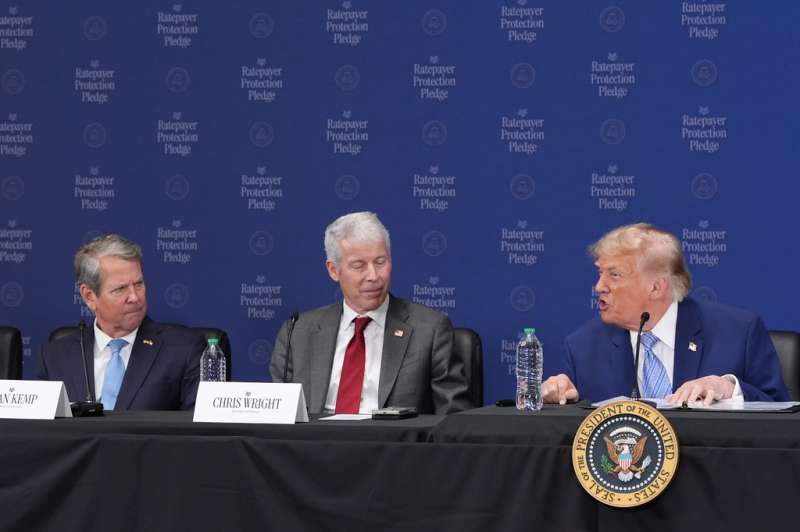
And Kemp has done nothing to separate himself from Georgia Power. In April, Kemp personally inducted Womack, the CEO of Southern Company, as a Georgia Trustee — the state’s highest honor. Just last week, he appeared alongside Womack during an event President Donald Trump hosted about energy affordability, raising questions about whether or not the governor could adequately regulate the company.
Kemp’s influence over the utility runs mostly through the PSC, whose five members are elected but whose vacancies the governor fills. His appointees have a track record of siding with Georgia Power. Jason Shaw, whom Kemp appointed to the commission, later became its chairman and has repeatedly voted for rate increases and against consumer-friendly reforms. Fitz Johnson, another Kemp appointee, followed a similar pattern until voters replaced him in the 2025 election.
Georgia voters instead elected Democratic candidate Peter Hubbard. “We can bring clean, reliable and affordable energy to Georgia. We can put money back in your pockets, not the pockets of utility executives. We can have a Public Service Commission that actually serves the public,” Hubbard said on the campaign trail.
Rooftop solar, stuck in place
One of the clearest examples of Kemp and the PSC siding with Georgia Power is the company’s net-metering program, which lets homeowners with rooftop solar sell excess power back to the grid. The program has been capped at just 5,000 customers since 2019, the year Kemp took office.
The PSC has repeatedly voted down proposals to expand it, even as advocates argued a bigger program would let more Georgians offset their own bills with rooftop solar. Kemp has not publicly pushed the commission to lift the cap.
Solar energy has become one of the cheapest sources of electricity in the United States. Unlike oil and gas, sunlight is free and plentiful. Allowing more residents to install solar panels could drastically reduce energy prices, particularly during spikes in the cost of oil, such as those caused by the United States’ recent war on Iran. However, Kemp and the PSC have continuously refused to do so.
Vetoing data center handouts
The clearest documented instance of Kemp actively blocking a renewable-friendly measure came in 2024, when he vetoed House Bill 1192.
The bill would have paused a tax break for data centers for two years and created a commission to study how the industry’s explosive growth was straining Georgia’s grid.
Environmental groups pushed hard for the bill, warning that data centers—which now account for the vast majority of Georgia Power’s projected new demand—were driving a return to fossil fuels. Kemp’s veto message focused on protecting economic certainty for data center investors, not on lowering prices for ratepayers.
Environment Georgia and the Sierra Club both called the veto a missed chance to study the tradeoffs before Georgia Power locked in years of new gas construction, as well as the potential impact on customers.
Instead, in December 2025, the PSC approved a Georgia Power request for nearly 9,900 megawatts of new generation—more than 3,600 megawatts of its new gas-fired power plants. About 80% of that new capacity is expected to serve AI data centers.
The broader pattern
None of this means Kemp personally caused Georgia’s rate increases. The data center boom reshaping electricity markets is a national phenomenon, not a Georgia-specific one. But at nearly every point where the governor could have pushed policy toward shielding ordinary ratepayers—by expanding rooftop solar or studying data centers’ energy impact and potential rate hikes—he has instead sided with Georgia Power and promises of future growth. For Georgians paying an extra $500 per year on their utility bills and concerned about the climate crisis, that bet seems unlikely to pay off.